
Species
Upland sandpiper
Bartramia longicauda
A grassland sandpiper with a pigeon-like head that perches on fence posts, passing through Georgia in migration.
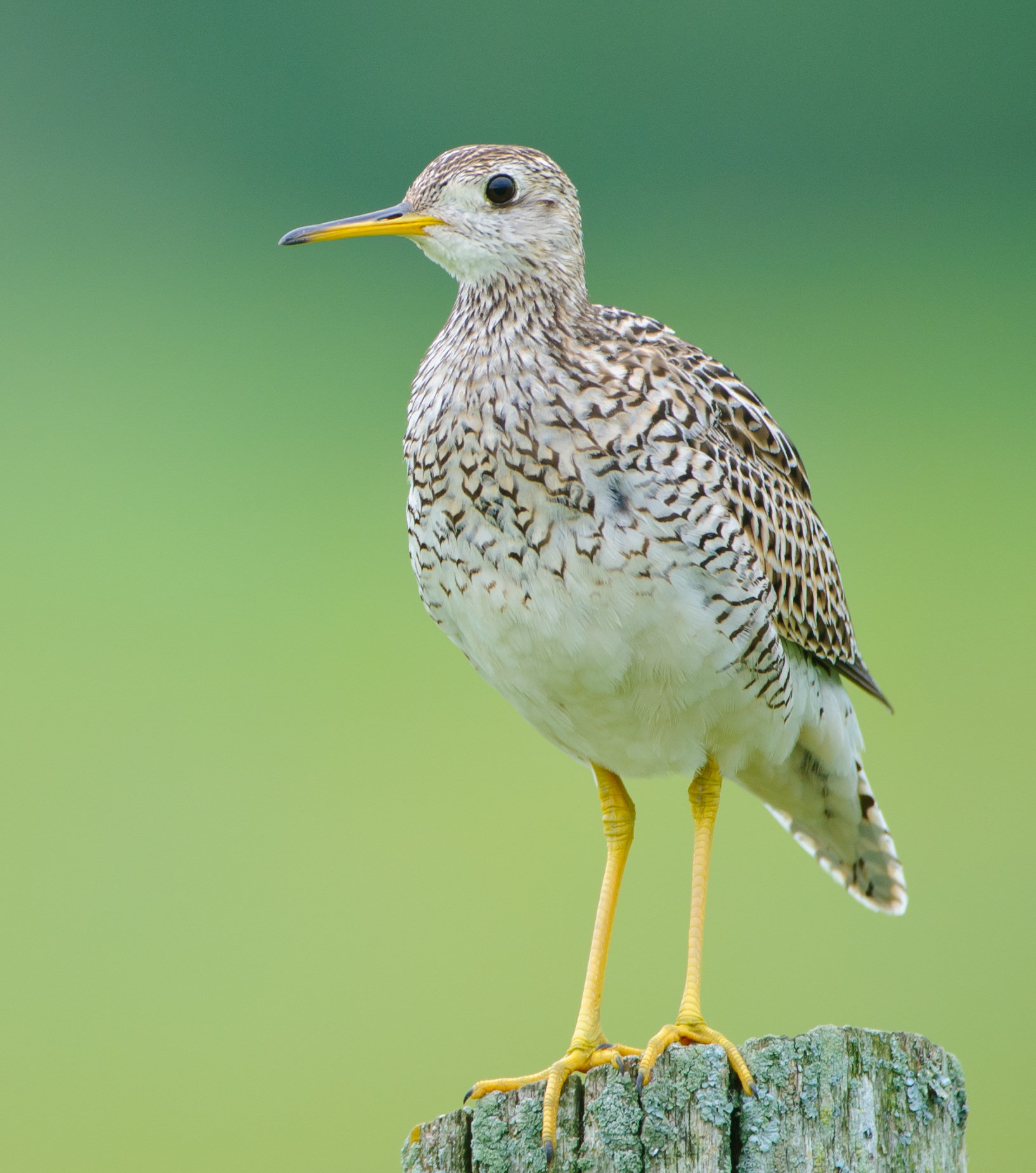
Photo Johnath (opens in a new tab) / Wikimedia Commons, CC BY-SA 3.0 (opens in a new tab)
At a glance
- Size
- About 28 to 32 cm long
- Weight
- About 100 to 230 g
- Habitat
- Short-grass fields, pastures, turf farms and airports
- Diet
- Insects, especially grasshoppers and beetles
- In Georgia
- An uncommon migrant, mostly in spring and late summer
- Voice
- A long, rising and falling wolf-whistle
- Rabies vector
- No
Identification
- Key marks
- Small head on a long, thin neck; large dark eye; short yellow bill; long tail; buff and brown streaked body
- Told apart from
- Buff-breasted sandpiper, which has a plain buff face and breast and a short neck
- Where to look
- Turf farms and short-grass fields, and fence posts beside them
Behaviour
Upland sandpipers live in grasslands, not on shores. They often land on posts and hold their wings upright for a moment before folding them.
Why they matter
Upland sandpipers were once shot in huge numbers and lost much of their prairie breeding habitat to farming. They migrate between North American grasslands and the pampas of South America, and they depend on grasslands at both ends.
Reproduction and lifecycle
Nest — A grass-lined scrape hidden in tall grass
Eggs — Usually four
Incubation — About 21 to 27 days
Chicks — Leave the nest within a day
Flight — At about 30 days
Lifespan — Several years
Living around people
- Airports and turf farms are among their stopovers; mowing and pesticides affect them.
Misconceptions
- Sandpipers only live on beaches. The upland sandpiper lives in grasslands.
Related species
Seasonal activity
When this species is breeding, and when there are nests on the ground. Mowing during the shaded months is how most nests are found.
| Jan | Feb | Mar | Apr | May | Jun | Jul | Aug | Sep | Oct | Nov | Dec | |
|---|---|---|---|---|---|---|---|---|---|---|---|---|
| Breeding | Jan: no | Feb: no | Mar: no | Apr: no | May: no | Jun: no | Jul: no | Aug: no | Sep: no | Oct: no | Nov: no | Dec: no |
| Active nests | Jan: no | Feb: no | Mar: no | Apr: no | May: no | Jun: no | Jul: no | Aug: no | Sep: no | Oct: no | Nov: no | Dec: no |
| Notes | In South America | In South America | Migrants passing | Migrants passing | Nesting in northern grasslands | Nesting | Adults begin moving south | Migrants passing | Migrants passing | In South America | In South America | In South America |
Where it lives
Recorded in 47 states and provinces. Each one links to the other animals there, and to the rehabilitators licensed for them.
United States
- Alabamapassing through
- Alaskabreeding
- Arkansaspassing through
- Coloradobreeding
- Georgiapassing through
- Illinoisbreeding
- Indianabreeding
- Iowabreeding
- Kansasbreeding
- Louisianapassing through
- Mainebreeding
- Massachusettsbreeding
- Michiganbreeding
- Minnesotabreeding
- Mississippipassing through
- Missouribreeding
- Montanabreeding
- Nebraskabreeding
- New Hampshirebreeding
- New Jerseypassing through
- New Yorkbreeding
- North Dakotabreeding
- Ohiobreeding
- Oklahomabreeding
- Pennsylvaniabreeding
- South Dakotabreeding
- Texaspassing through
- Vermontbreeding
- Wisconsinbreeding
- Wyomingbreeding
Canada
If you found one
Answer a few questions and you will get a specific answer for what you are looking at.
I found an animal