
Species
Short-eared owl
Asio flammeus
A moth-like owl of open grasslands and marshes that hunts at dusk, a scarce winter visitor to Georgia.
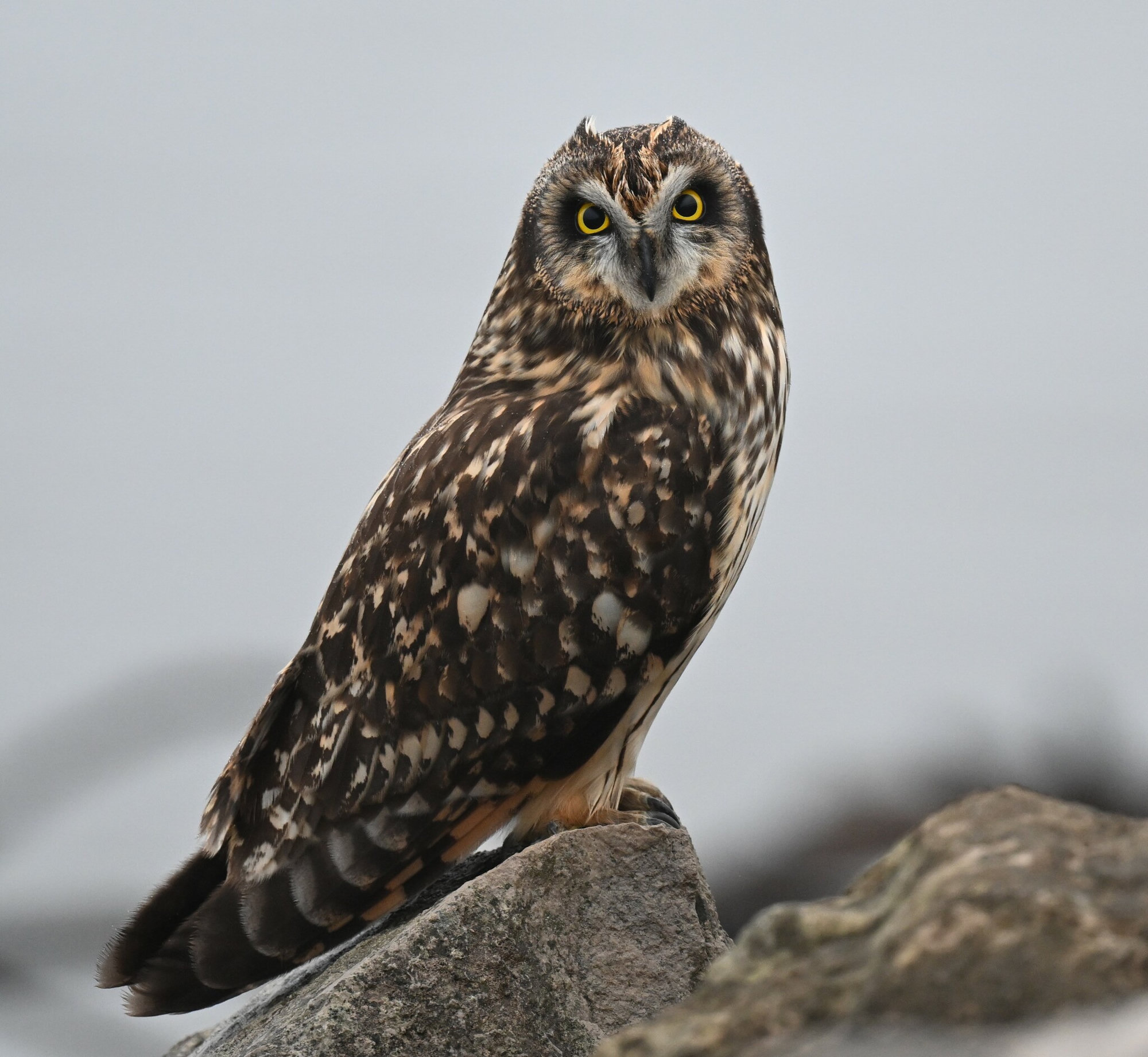
Photo Unknown photographer (opens in a new tab) / iNaturalist, CC0 1.0 (opens in a new tab)
At a glance
- Size
- About 34 to 43 cm long; wingspan about 85 to 103 cm
- Weight
- About 200 to 475 g
- Habitat
- Grasslands, marshes and open fields
- Diet
- Voles and mice
- In Georgia
- A rare winter visitor
- Voice
- Mostly silent in winter
- Rabies vector
- No
Identification
- Key marks
- Buff and brown; short ear tufts, rarely visible; yellow eyes in dark patches; floppy, moth-like flight; dark patches at the wrist
- Told apart from
- Northern harrier, which has a white rump and flies lower in daylight
- Where to look
- Large grassy fields and marshes at dusk, December to February
Behaviour
Short-eared owls hunt low over open ground at dawn and dusk with a floppy, moth-like flight. They roost on the ground in tall grass.
Why they matter
Short-eared owls depend on large open grasslands and marshes, which have declined across the East. They follow vole populations, turning up where rodents are abundant.
Reproduction and lifecycle
Nest — A scrape on the ground in grass, lined with grass and feathers
Eggs — Usually four to seven
Incubation — About 24 to 29 days
Chicks — Leave the nest at about two weeks, before they can fly
Flight — At about four to five weeks
Lifespan — Several years
Living around people
- Large fields and marshes left unmown in winter give them hunting ground.
Misconceptions
- All owls live in woods. Short-eared owls live in open grassland.
Related species
Seasonal activity
When this species is breeding, and when there are nests on the ground. Mowing during the shaded months is how most nests are found.
| Jan | Feb | Mar | Apr | May | Jun | Jul | Aug | Sep | Oct | Nov | Dec | |
|---|---|---|---|---|---|---|---|---|---|---|---|---|
| Breeding | Jan: no | Feb: no | Mar: no | Apr: no | May: no | Jun: no | Jul: no | Aug: no | Sep: no | Oct: no | Nov: no | Dec: no |
| Active nests | Jan: no | Feb: no | Mar: no | Apr: no | May: no | Jun: no | Jul: no | Aug: no | Sep: no | Oct: no | Nov: no | Dec: no |
| Notes | Wintering | Wintering | Leaving | Migrating north | Nesting farther north | Nesting | Chicks | Young flying | Migration begins | Moving south | Arriving | Wintering |
Where it lives
Recorded in 65 states and provinces. Each one links to the other animals there, and to the rehabilitators licensed for them.
United States
- Alaska
- Arkansasin winter
- Californiain winter
- Coloradoin winter
- Connecticutin winter
- Delawarein winter
- District of Columbiapassing through
- Floridain winter
- Georgiain winter
- Hawaii
- Idaho
- Illinoisin winter
- Indianain winter
- Iowain winter
- Kansasin winter
- Kentuckyin winter
- Louisianain winter
- Mainein winter
- Marylandin winter
- Massachusettsin winter
- Michiganin winter
- Minnesotain winter
- Mississippiin winter
- Missouriin winter
- Montana
- Nebraskain winter
- Nevada
- New Hampshirein winter
- New Jerseyin winter
- New Yorkin winter
- North Carolinain winter
- North Dakota
- Ohioin winter
- Oklahomain winter
- Oregonin winter
- Pennsylvaniain winter
- Rhode Islandin winter
- South Carolinain winter
- South Dakota
- Tennesseein winter
- Texasin winter
- Utah
- Vermontin winter
- Virginiain winter
- Washingtonin winter
- West Virginiain winter
- Wisconsinin winter
- Wyoming
Canada
If you found one
Answer a few questions and you will get a specific answer for what you are looking at.
I found an animal