
Species
Ruddy duck
Oxyura jamaicensis
A small, stiff-tailed diving duck; males in breeding plumage have a sky-blue bill and a cocked tail.
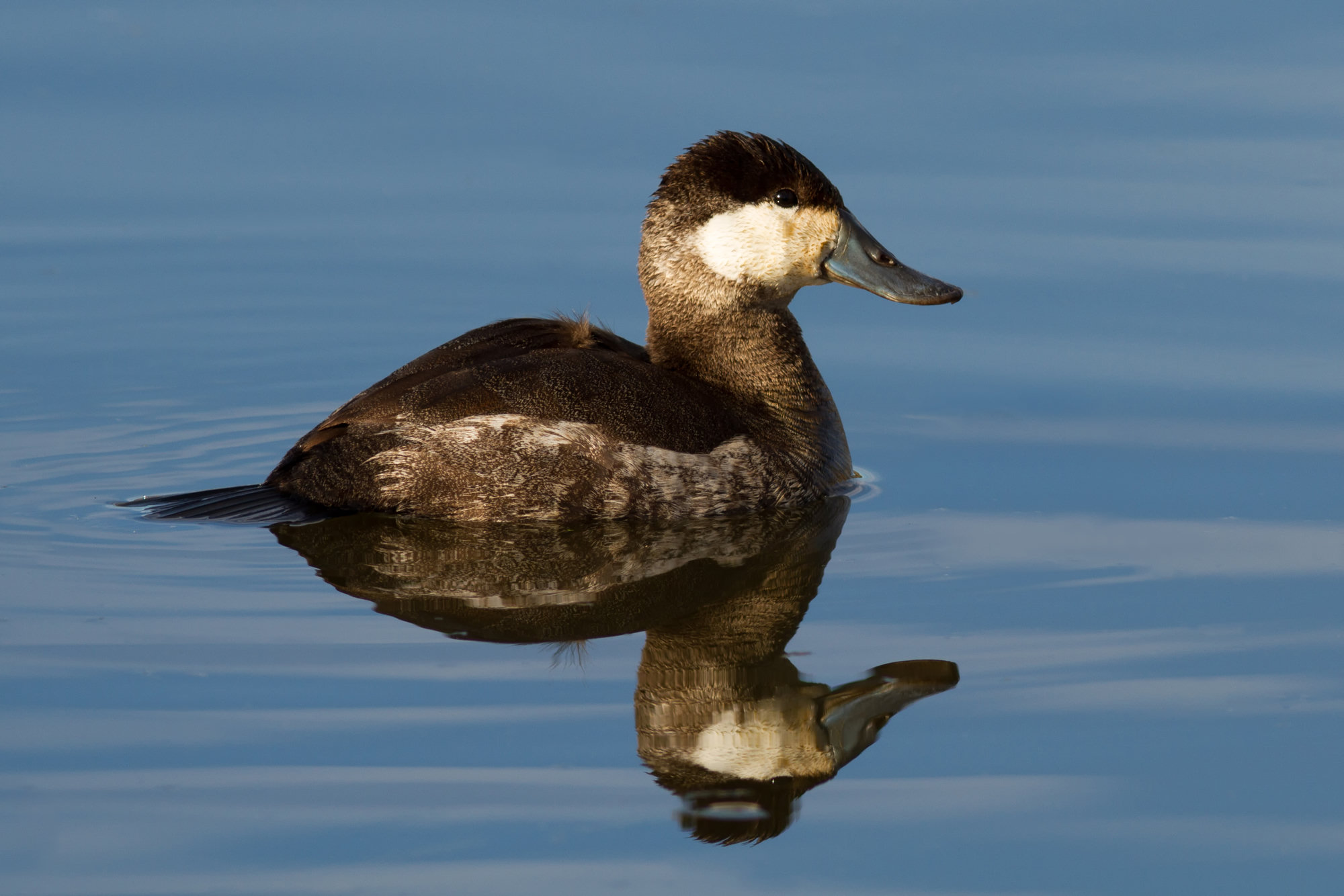
Photo Frank Schulenburg (opens in a new tab) / Wikimedia Commons, CC BY-SA 3.0 (opens in a new tab)
At a glance
- Size
- About 35 to 43 cm long
- Weight
- About 300 to 800 g
- Habitat
- Ponds, lakes, reservoirs and treatment ponds
- Diet
- Insect larvae, small crustaceans, snails and seeds
- In Georgia
- A common winter visitor, November to April
- Voice
- Mostly quiet; males make a drumming, bubbling display
- Rabies vector
- No
Identification
- Key marks
- Chunky body; large head; stiff tail often held cocked upright
- Male
- In winter grey-brown with white cheeks and a dark cap; in spring chestnut with a bright blue bill
- Female
- Brown with a dark line across a pale cheek
- Told apart from
- Bufflehead, which has a white body and no stiff tail
- Where to look
- Open water on ponds and lakes, often in tight flocks
Behaviour
Ruddy ducks dive for small animals on muddy bottoms and are so poorly suited to walking that they seldom leave the water. In display, males beat their bills against their chests, making bubbles rise from their breast feathers.
Why they matter
Ruddy ducks lay eggs that are huge for their body size — a clutch can weigh more than the female. Their stiff tails, used as rudders underwater, belong to a small group of ducks found around the world, and they are an unusual sight among Georgia's winter ducks.
Reproduction and lifecycle
Nest — A woven basket in marsh plants over water
Eggs — Usually 5 to 10, very large for the bird's size
Incubation — About 23 to 26 days
Ducklings — Leave the nest within a day and are largely independent early
Flight — At about seven weeks
Lifespan — Usually a few years
Living around people
- Stormwater ponds and treatment ponds attract wintering ruddy ducks for their insect larvae.
- On land, ruddy ducks can barely walk; one found on a road or car park after a storm needs a rehabilitator.
Misconceptions
- A duck on a wet road is fine. Diving ducks sometimes mistake wet pavement for water at night and cannot take off from land.
Related species
Seasonal activity
When this species is breeding, and when there are nests on the ground. Mowing during the shaded months is how most nests are found.
| Jan | Feb | Mar | Apr | May | Jun | Jul | Aug | Sep | Oct | Nov | Dec | |
|---|---|---|---|---|---|---|---|---|---|---|---|---|
| Breeding | Jan: no | Feb: no | Mar: no | Apr: no | May: no | Jun: no | Jul: no | Aug: no | Sep: no | Oct: no | Nov: no | Dec: no |
| Active nests | Jan: no | Feb: no | Mar: no | Apr: no | May: no | Jun: no | Jul: no | Aug: no | Sep: no | Oct: no | Nov: no | Dec: no |
| Notes | Wintering | Wintering | Males moulting into breeding plumage | Migrating north | Nesting on northern marshes | Nesting | Ducklings hatching | Young growing | Migration begins | Moving south | Arriving in Georgia | Wintering |
Where it lives
Recorded in 84 states and provinces. Each one links to the other animals there, and to the rehabilitators licensed for them.
United States
- Alabamain winter
- Arizonain winter
- Arkansasin winter
- Californiain winter
- Colorado
- Connecticutin winter
- Delawarein winter
- District of Columbiain winter
- Floridain winter
- Georgiain winter
- Idaho
- Illinoisin winter
- Indianain winter
- Iowain winter
- Kansas
- Kentuckyin winter
- Louisianain winter
- Mainein winter
- Marylandin winter
- Massachusettsin winter
- Michigan
- Minnesota
- Mississippiin winter
- Missouriin winter
- Montanabreeding
- Nebraska
- Nevada
- New Hampshirein winter
- New Jerseyin winter
- New Mexicoin winter
- New Yorkin winter
- North Carolinain winter
- North Dakotabreeding
- Ohioin winter
- Oklahomain winter
- Oregonin winter
- Pennsylvaniain winter
- Rhode Islandin winter
- South Carolinain winter
- South Dakotabreeding
- Tennesseein winter
- Texasin winter
- Utahin winter
- Virginiain winter
- Washington
- West Virginiain winter
- Wisconsin
- Wyomingbreeding
Canada
Mexico
- Aguascalientes
- Baja California
- Baja California Sur
- Chihuahua
- Coahuilain winter
- Colimain winter
- Durango
- Guanajuato
- Guerreroin winter
- Hidalgoin winter
- Jalisco
- Mexico City
- Michoacanin winter
- Morelosin winter
- Nayaritin winter
- Nuevo Leonin winter
- Oaxacain winter
- Puebla
- Queretaro
- San Luis Potosiin winter
- Sinaloain winter
- Sonorain winter
- State of Mexico
- Tamaulipasin winter
- Tlaxcalain winter
- Veracruzin winter
- Zacatecasin winter
If you found one
Answer a few questions and you will get a specific answer for what you are looking at.
I found an animal