
Species
Ring-necked snake
Diadophis punctatus
A small, slate-grey snake with a golden collar and a bright belly it flashes when disturbed.
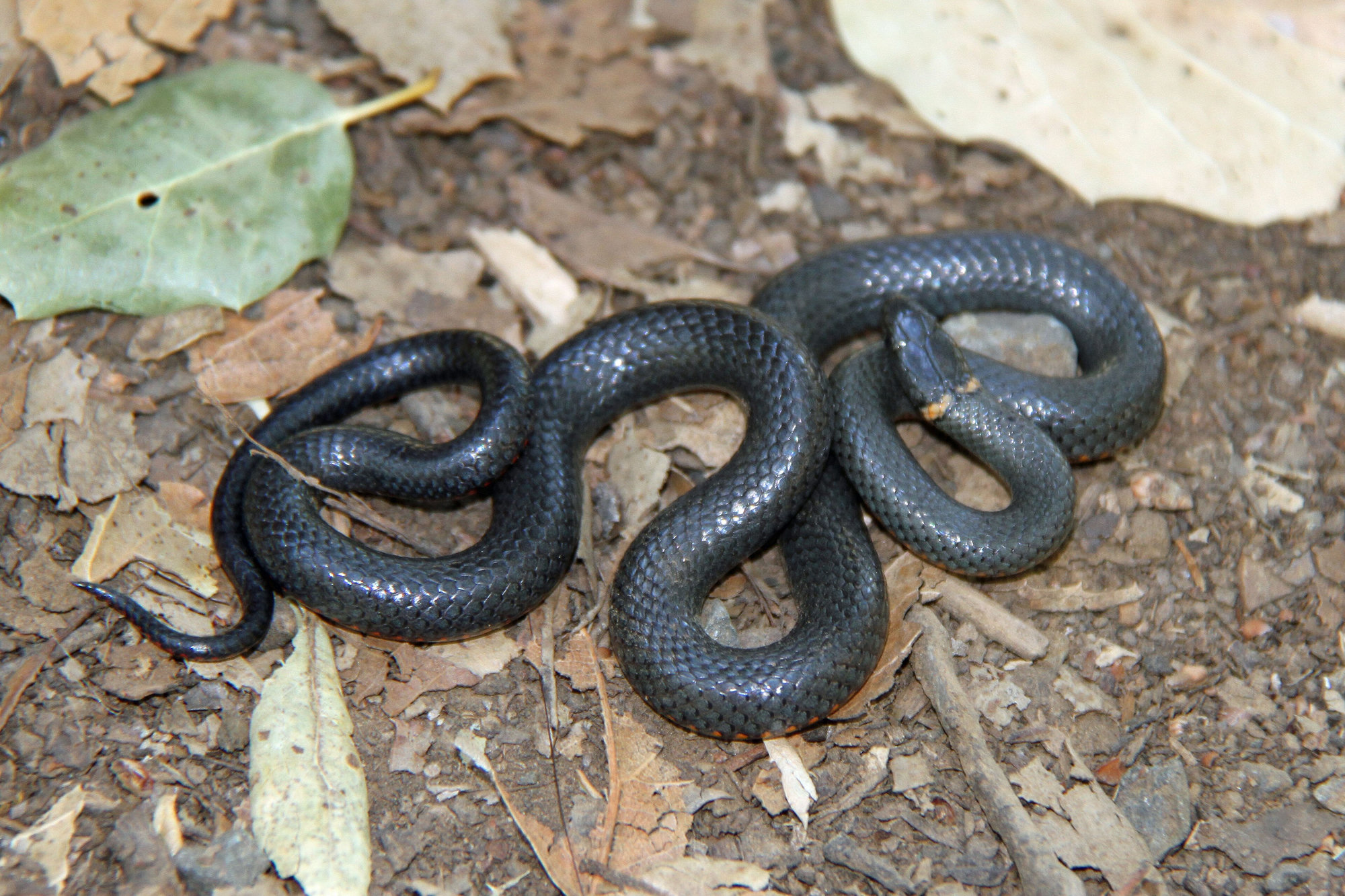
Photo Greg Schechter (opens in a new tab) / Wikimedia Commons, CC BY 2.0 (opens in a new tab)
At a glance
- Size
- Usually 25 to 40 cm long
- Habitat
- Moist woods, rocky hillsides and gardens
- Diet
- Salamanders, earthworms, slugs and small snakes
- In Georgia
- Common statewide
- Venomous
- No
- Rabies vector
- No
Identification
- Key marks
- Smooth, dark grey to black; yellow or orange ring around the neck; yellow to red belly
- Told apart from
- Red-bellied snake, which has no collar
- Where to look
- Under logs, bark and stones in damp woods
Behaviour
When threatened a ring-necked snake coils its tail to show the bright underside and may release musk. It hunts at night and in damp weather, and small groups sometimes shelter together.
Why they matter
It is one of the most numerous snakes in the eastern woods and a major predator of salamanders and worms, and food for birds and larger snakes.
Reproduction and lifecycle
Eggs — Usually 2 to 7
Nest — Under logs and stones, sometimes shared
Incubation — About 6 to 8 weeks
Hatchlings — Miniatures of the adults
Maturity — In two to three years
Lifespan — Over 10 years
Living around people
- It is harmless; leave it under its cover.
Misconceptions
- Brightly coloured snakes are venomous. The ring-necked snake's colours are a bluff.
Related species
Seasonal activity
When this species is breeding, and when there are nests on the ground. Mowing during the shaded months is how most nests are found.
| Jan | Feb | Mar | Apr | May | Jun | Jul | Aug | Sep | Oct | Nov | Dec | |
|---|---|---|---|---|---|---|---|---|---|---|---|---|
| Breeding | Jan: no | Feb: no | Mar: no | Apr: no | May: no | Jun: no | Jul: no | Aug: no | Sep: no | Oct: no | Nov: no | Dec: no |
| Active nests | Jan: no | Feb: no | Mar: no | Apr: no | May: no | Jun: no | Jul: no | Aug: no | Sep: no | Oct: no | Nov: no | Dec: no |
| Notes | Sheltering | Sheltering | Emerging | Mating | Active | Laying | Active | Hatching | Mating | Active | Sheltering | Sheltering |
Where it lives
Recorded in 64 states and provinces. Each one links to the other animals there, and to the rehabilitators licensed for them.
United States
- Alabama
- Arizona
- Arkansas
- California
- Colorado
- Connecticut
- Delaware
- District of Columbia
- Florida
- Georgia
- Idaho
- Illinois
- Indiana
- Iowa
- Kansas
- Kentucky
- Louisiana
- Maine
- Maryland
- Massachusetts
- Michigan
- Minnesota
- Mississippi
- Missouri
- Nebraska
- Nevada
- New Hampshire
- New Jersey
- New Mexico
- New York
- North Carolina
- Ohio
- Oklahoma
- Oregon
- Pennsylvania
- Rhode Island
- South Carolina
- South Dakota
- Tennessee
- Texas
- Utah
- Vermont
- Virginia
- Washington
- West Virginia
- Wisconsin
If you found one
Answer a few questions and you will get a specific answer for what you are looking at.
I found an animal