
Species
Red-bellied snake
Storeria occipitomaculata
A tiny woodland snake with a bright red belly, often turned up under logs and leaves.
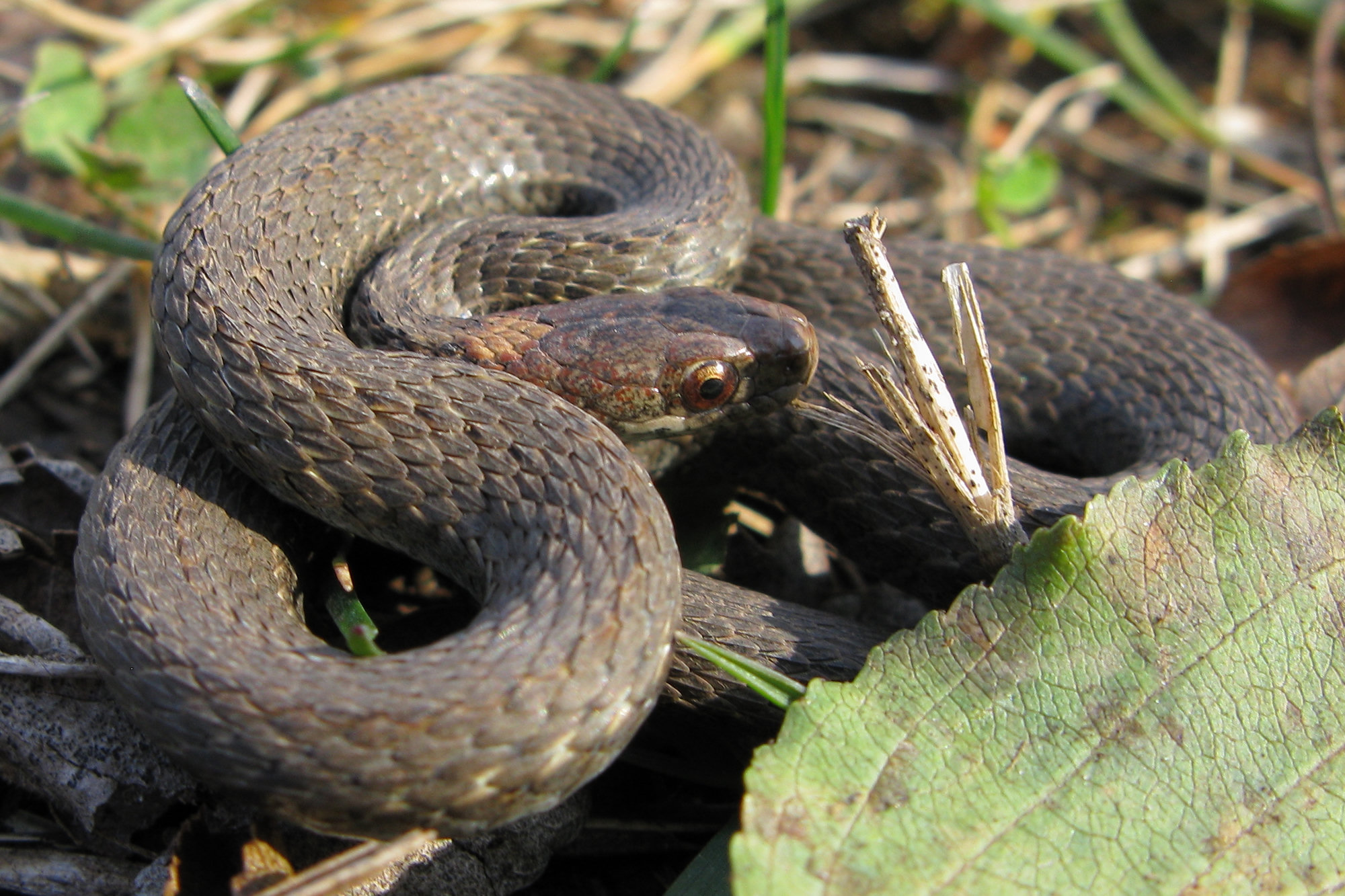
Photo Chris Falt (opens in a new tab) / Wikimedia Commons, CC BY-SA 2.0 (opens in a new tab)
At a glance
- Size
- Usually 20 to 30 cm long
- Habitat
- Moist woods, bogs and meadows
- Diet
- Slugs, snails and earthworms
- In Georgia
- Mainly the mountains and Piedmont, scattered farther south
- Venomous
- No
- Rabies vector
- No
Identification
- Key marks
- Small, brown, grey or black above; bright red or orange belly; three pale spots at the back of the head
- Told apart from
- DeKay's brownsnake, which has a pale belly
- Told apart from
- Ring-necked snake, which has a yellow or orange collar
- Where to look
- Under logs, stones and leaf litter in damp woods
Behaviour
When threatened a red-bellied snake may curl its upper lip in a snarl or flip over to show the red belly. It is harmless and cannot bite through skin.
Why they matter
It eats slugs and snails in woodland and gardens and is food for many birds and larger snakes.
Reproduction and lifecycle
Young — Born live, usually 1 to 13
Size at birth — About 7 to 10 cm
Maturity — In about two years
Breeding — Every year
Lifespan — A few years
Habits — Mostly under cover
Living around people
- It is harmless and eats slugs; leave it under its log.
Misconceptions
- A snake that snarls is dangerous. The lip-curl is a bluff by a harmless snake.
Related species
Seasonal activity
When this species is breeding, and when there are nests on the ground. Mowing during the shaded months is how most nests are found.
| Jan | Feb | Mar | Apr | May | Jun | Jul | Aug | Sep | Oct | Nov | Dec | |
|---|---|---|---|---|---|---|---|---|---|---|---|---|
| Breeding | Jan: no | Feb: no | Mar: no | Apr: no | May: no | Jun: no | Jul: no | Aug: no | Sep: no | Oct: no | Nov: no | Dec: no |
| Active nests | Jan: no | Feb: no | Mar: no | Apr: no | May: no | Jun: no | Jul: no | Aug: no | Sep: no | Oct: no | Nov: no | Dec: no |
| Notes | Sheltering | Sheltering | Emerging | Mating | Active | Active | Young born | Young born | Active | Active | Sheltering | Sheltering |
Where it lives
Recorded in 46 states and provinces. Each one links to the other animals there, and to the rehabilitators licensed for them.
United States
- Alabama
- Arkansas
- Connecticut
- Florida
- Georgia
- Illinois
- Indiana
- Iowa
- Kentucky
- Louisiana
- Maine
- Maryland
- Massachusetts
- Michigan
- Minnesota
- Mississippi
- Missouri
- Nebraska
- New Hampshire
- New Jersey
- New York
- North Carolina
- North Dakota
- Ohio
- Oklahoma
- Pennsylvania
- Rhode Island
- South Carolina
- South Dakota
- Tennessee
- Texas
- Vermont
- Virginia
- West Virginia
- Wisconsin
If you found one
Answer a few questions and you will get a specific answer for what you are looking at.
I found an animal