
Species
Red crossbill
Loxia curvirostra
A finch whose crossed bill tips pry open pine cones, wandering the mountains in search of seed crops.
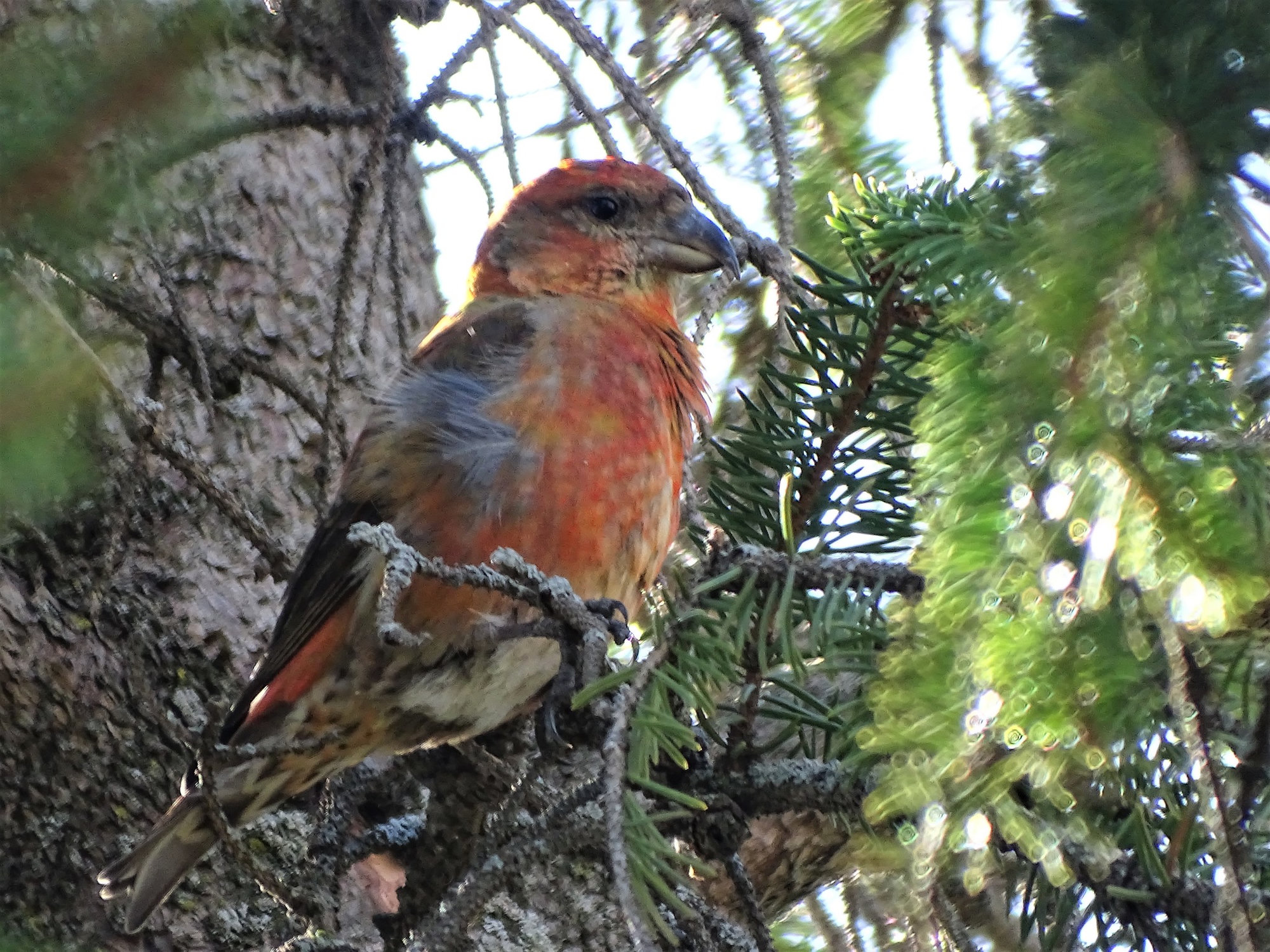
Photo Shirley Zundell (opens in a new tab) / iNaturalist, CC BY 4.0 (opens in a new tab)
At a glance
- Size
- About 14 to 17 cm long
- Weight
- About 24 to 40 g
- Habitat
- Pine and spruce forests
- Diet
- Conifer seeds
- In Georgia
- An irregular resident and visitor in the mountains
- Voice
- A sharp "kip-kip" in flight
- Rabies vector
- No
Identification
- Key marks
- Crossed bill tips; males brick-red, females olive-yellow
- Told apart from
- House finch, which has a normal, thick bill
- Where to look
- Pine forests in the mountains, where cones are plentiful
Behaviour
Red crossbills use their crossed bills to pry open cone scales and extract seeds with their tongues. They breed whenever seed crops are good, even in winter.
Why they matter
Red crossbills include several "types" with different calls and bill sizes, each suited to particular conifers. Scientists are still working out whether some are separate species.
Reproduction and lifecycle
Nest — A cup in a conifer
Eggs — Usually three or four
Incubation — About 12 to 16 days
Chicks — Fed by both parents; their bills are straight at hatching and cross as they grow
Lifespan — Several years
Living around people
- Crossbills sometimes eat salt and grit on roads and are hit by cars.
Misconceptions
- The crossed bill is a deformity. It is the crossbill's specialised tool.
Related species
Seasonal activity
When this species is breeding, and when there are nests on the ground. Mowing during the shaded months is how most nests are found.
| Jan | Feb | Mar | Apr | May | Jun | Jul | Aug | Sep | Oct | Nov | Dec | |
|---|---|---|---|---|---|---|---|---|---|---|---|---|
| Breeding | Jan: no | Feb: no | Mar: no | Apr: no | May: no | Jun: no | Jul: no | Aug: no | Sep: no | Oct: no | Nov: no | Dec: no |
| Active nests | Jan: no | Feb: no | Mar: no | Apr: no | May: no | Jun: no | Jul: no | Aug: no | Sep: no | Oct: no | Nov: no | Dec: no |
| Notes | Wandering; may nest if cones are plentiful | Wandering | Wandering | Wandering | Wandering | Wandering | Wandering | Wandering | Wandering | Wandering | Wandering | Wandering |
Where it lives
Recorded in 61 states and provinces. Each one links to the other animals there, and to the rehabilitators licensed for them.
United States
- Alaska
- Arizona
- California
- Colorado
- Connecticutin winter
- Georgia
- Idaho
- Iowain winter
- Kansasin winter
- Maine
- Massachusettsin winter
- Michigan
- Minnesotain winter
- Montana
- Nebraska
- Nevada
- New Hampshire
- New Mexico
- New York
- North Carolina
- North Dakota
- Oregonbreeding
- Rhode Islandin winter
- South Dakota
- Tennessee
- Utahbreeding
- Vermont
- Virginia
- Washington
- West Virginia
- Wisconsin
- Wyoming
Canada
If you found one
Answer a few questions and you will get a specific answer for what you are looking at.
I found an animal