
Species
Red-cockaded woodpecker
Dryobates borealis
A federally protected woodpecker that drills its nest holes in living, old longleaf pines, and lives in cooperative family groups.
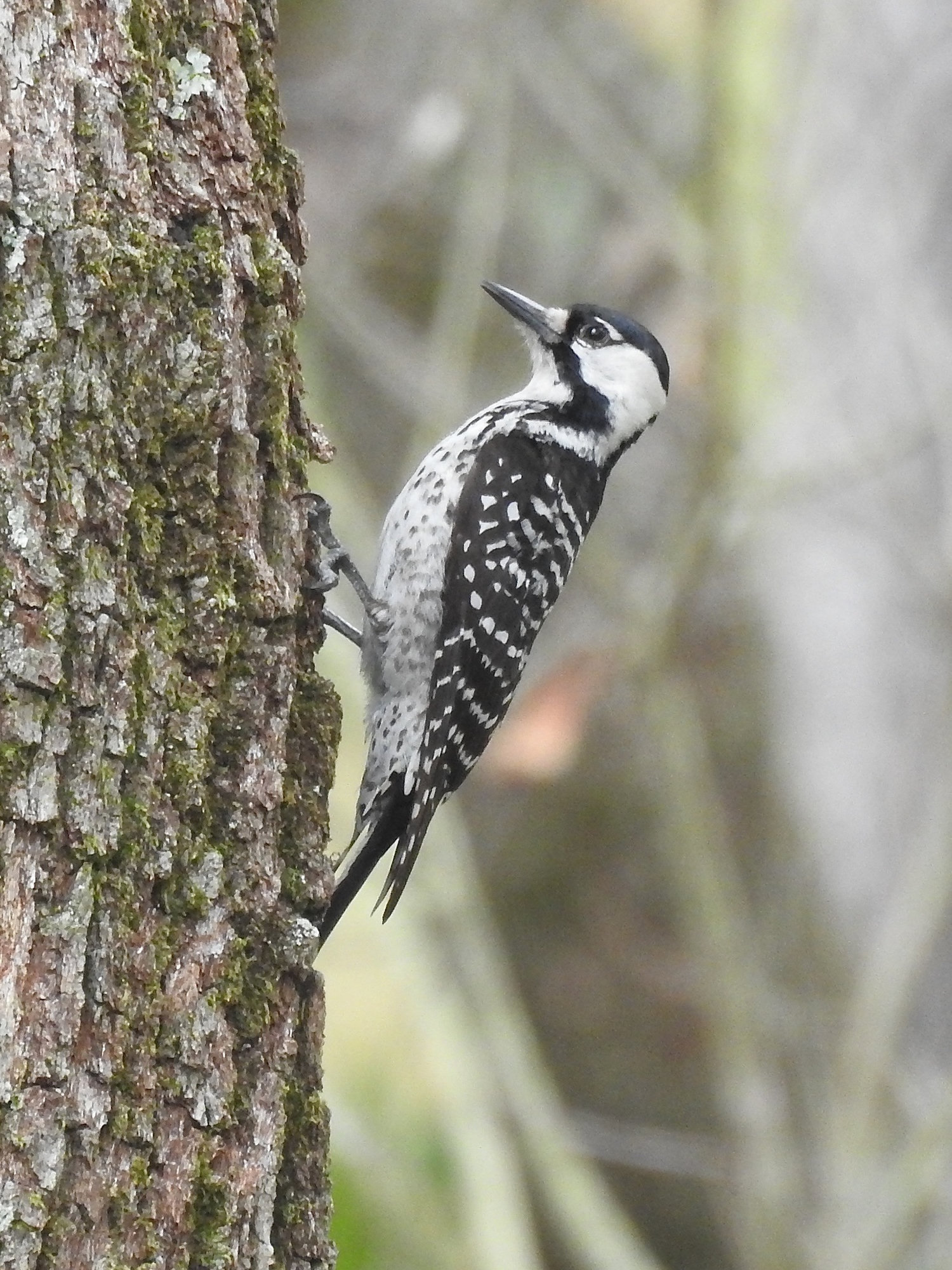
Photo Laura Gaudette (opens in a new tab) / iNaturalist, CC BY 4.0 (opens in a new tab)
At a glance
- Size
- About 20 to 23 cm long
- Weight
- About 40 to 55 g
- Habitat
- Open, mature pine forests, especially longleaf pine, kept open by fire
- Diet
- Insects and spiders from pine bark; some pine seeds and fruit
- In Georgia
- A rare, federally protected resident, mostly in the south of the state
- Voice
- A raspy "sripp"
- Rabies vector
- No
Identification
- Key marks
- Black cap and nape; large white cheek patch; black-and-white barred back; males with a tiny red streak ("cockade") behind the eye, rarely visible
- Told apart from
- Downy and hairy woodpeckers, which have white backs and no large white cheek
- Where to look
- Managed longleaf pine forests; trees with nest holes ringed by sticky resin
Behaviour
Red-cockaded woodpeckers live in family groups, in which young males stay to help their parents raise the next broods. They drill nest cavities in living old pines, taking months or years to finish one, and keep sap flowing around the entrance to deter rat snakes.
Why they matter
This is the only North American woodpecker that excavates cavities in living pines. Its holes are later used by many other animals. It became endangered as old longleaf pine forests were logged, and it recovered enough — where forests are managed with fire and given artificial cavities — to be reclassified as threatened in 2024. Georgia's pine forests are important to its future.
Reproduction and lifecycle
Nest — A cavity in a living pine, surrounded by resin wells
Eggs — Usually three or four
Incubation — About 10 to 11 days, one of the shortest of any bird
Chicks — Fed by the parents and helpers
Flight — At about 26 days
Family — Young males often stay as helpers
Lifespan — Wild birds over fifteen years are recorded
Living around people
- Cavity trees are marked in managed forests and must not be disturbed.
- Prescribed fire keeps the open pine forests they need.
Misconceptions
- Woodpeckers only nest in dead trees. Red-cockaded woodpeckers nest in living pines.
Related species
Seasonal activity
When this species is breeding, and when there are nests on the ground. Mowing during the shaded months is how most nests are found.
| Jan | Feb | Mar | Apr | May | Jun | Jul | Aug | Sep | Oct | Nov | Dec | |
|---|---|---|---|---|---|---|---|---|---|---|---|---|
| Breeding | Jan: no | Feb: no | Mar: no | Apr: no | May: no | Jun: no | Jul: no | Aug: no | Sep: no | Oct: no | Nov: no | Dec: no |
| Active nests | Jan: no | Feb: no | Mar: no | Apr: no | May: no | Jun: no | Jul: no | Aug: no | Sep: no | Oct: no | Nov: no | Dec: no |
| Notes | Family groups | Family groups | Pairs preparing to nest | Nesting | Chicks | Young fledging | Family groups | Family groups | Family groups | Family groups | Family groups | Family groups |
Where it lives
Recorded in 11 states and provinces. Each one links to the other animals there, and to the rehabilitators licensed for them.
If you found one
Answer a few questions and you will get a specific answer for what you are looking at.
I found an animal