
Species
Horned lark
Eremophila alpestris
A ground-dwelling songbird with tiny black 'horns', living on bare fields and airports in Georgia.
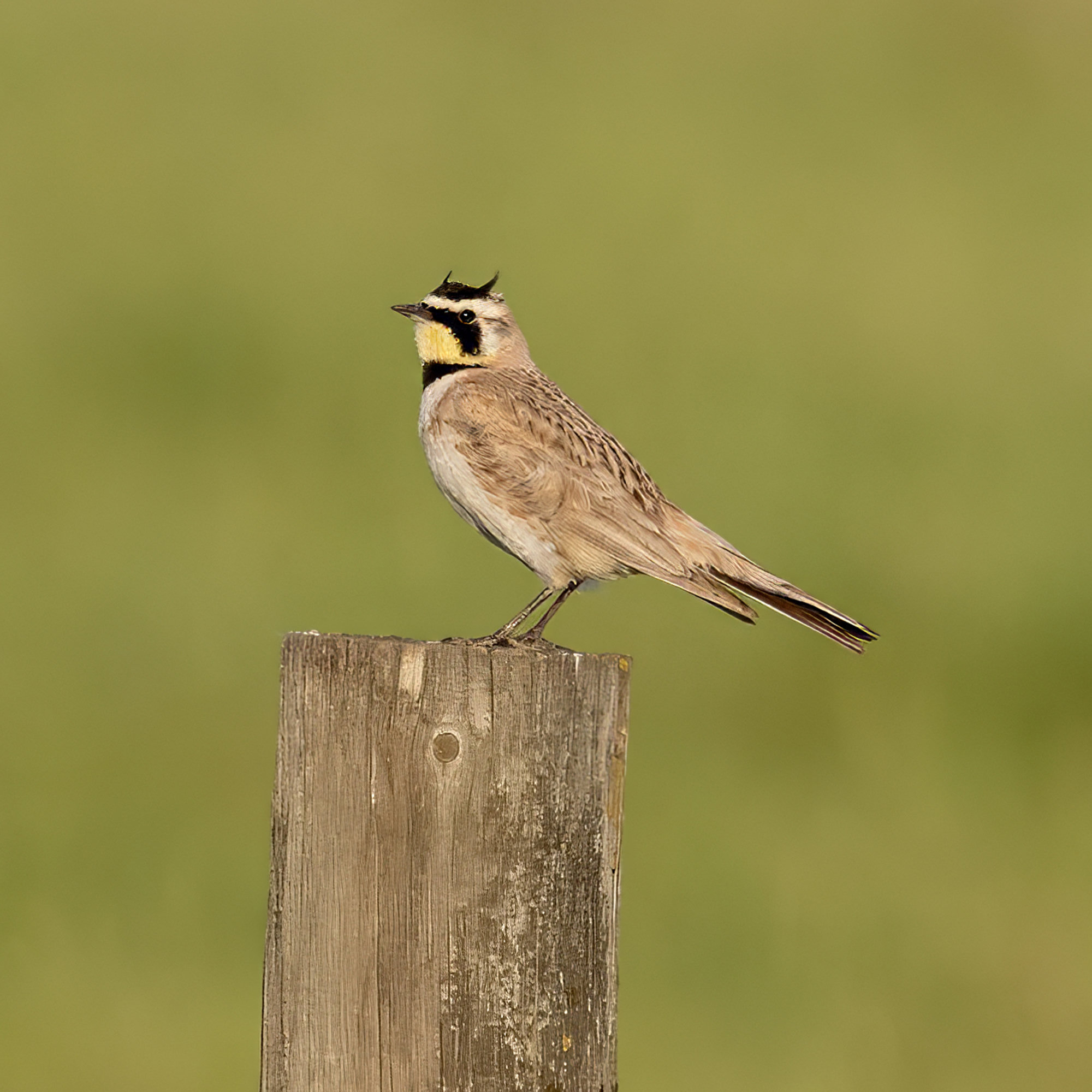
Photo Dan Vickers (opens in a new tab) / iNaturalist, CC BY 4.0 (opens in a new tab)
At a glance
- Size
- About 16 to 20 cm long
- Weight
- About 28 to 40 g
- Habitat
- Bare fields, ploughed land, airports and short turf
- Diet
- Seeds and insects
- In Georgia
- An uncommon resident in open farmland; more in winter
- Voice
- A high, tinkling song; a thin "tsee-titi" call
- Rabies vector
- No
Identification
- Key marks
- Brown above; black mask and breast band; yellow or white face; tiny black feather "horns" on males
- Told apart from
- American pipit, which is slim with no black face markings
- Told apart from
- Lapland longspur, which has a rusty nape in some plumages and a streaked back
- Where to look
- Bare fields, especially in winter
Behaviour
Horned larks walk rather than hop, feeding on seeds on bare ground. Males sing in high display flights, then dive back to earth.
Why they matter
Horned larks are one of the few songbirds adapted to wide, open, bare ground. They have declined across North America as farming practices changed, and they depend on large open fields.
Reproduction and lifecycle
Nest — A depression on bare ground lined with grass
Eggs — Usually three or four
Incubation — About 11 to 12 days
Chicks — Leave the nest at about 10 days, before they can fly
Flight — At about 15 days
Lifespan — Several years
Living around people
- Early ploughing and mowing destroy ground nests.
Misconceptions
- Larks live only in Europe. The horned lark is North America's only native lark.
Related species
Seasonal activity
When this species is breeding, and when there are nests on the ground. Mowing during the shaded months is how most nests are found.
| Jan | Feb | Mar | Apr | May | Jun | Jul | Aug | Sep | Oct | Nov | Dec | |
|---|---|---|---|---|---|---|---|---|---|---|---|---|
| Breeding | Jan: no | Feb: no | Mar: no | Apr: no | May: no | Jun: no | Jul: no | Aug: no | Sep: no | Oct: no | Nov: no | Dec: no |
| Active nests | Jan: no | Feb: no | Mar: no | Apr: no | May: no | Jun: no | Jul: no | Aug: no | Sep: no | Oct: no | Nov: no | Dec: no |
| Notes | Flocks in fields | Pairs singing | Nesting begins | Nesting | Chicks | Second broods | Young fledging | Present | Present | Flocks forming | Flocks | Flocks |
Where it lives
Recorded in 80 states and provinces. Each one links to the other animals there, and to the rehabilitators licensed for them.
United States
- Alabamain winter
- Alaskabreeding
- Arizona
- Arkansas
- California
- Colorado
- Connecticutin winter
- Delawarein winter
- Georgia
- Idaho
- Illinoisin winter
- Indianain winter
- Iowain winter
- Kansas
- Kentuckyin winter
- Louisiana
- Mainein winter
- Maryland
- Massachusettsin winter
- Michigan
- Minnesota
- Mississippiin winter
- Missouri
- Montana
- Nebraska
- Nevada
- New Hampshirein winter
- New Jerseyin winter
- New Mexico
- New Yorkin winter
- North Carolina
- North Dakota
- Ohioin winter
- Oklahoma
- Oregon
- Pennsylvaniain winter
- Rhode Islandin winter
- South Carolina
- South Dakota
- Tennesseein winter
- Texas
- Utah
- Vermontin winter
- Virginiain winter
- Washington
- West Virginiain winter
- Wisconsin
- Wyoming
Canada
If you found one
Answer a few questions and you will get a specific answer for what you are looking at.
I found an animal