
Species
Florida softshell
Apalone ferox
A big, flat, leathery-shelled turtle with a snorkel nose, from the ponds and canals of southern Georgia.
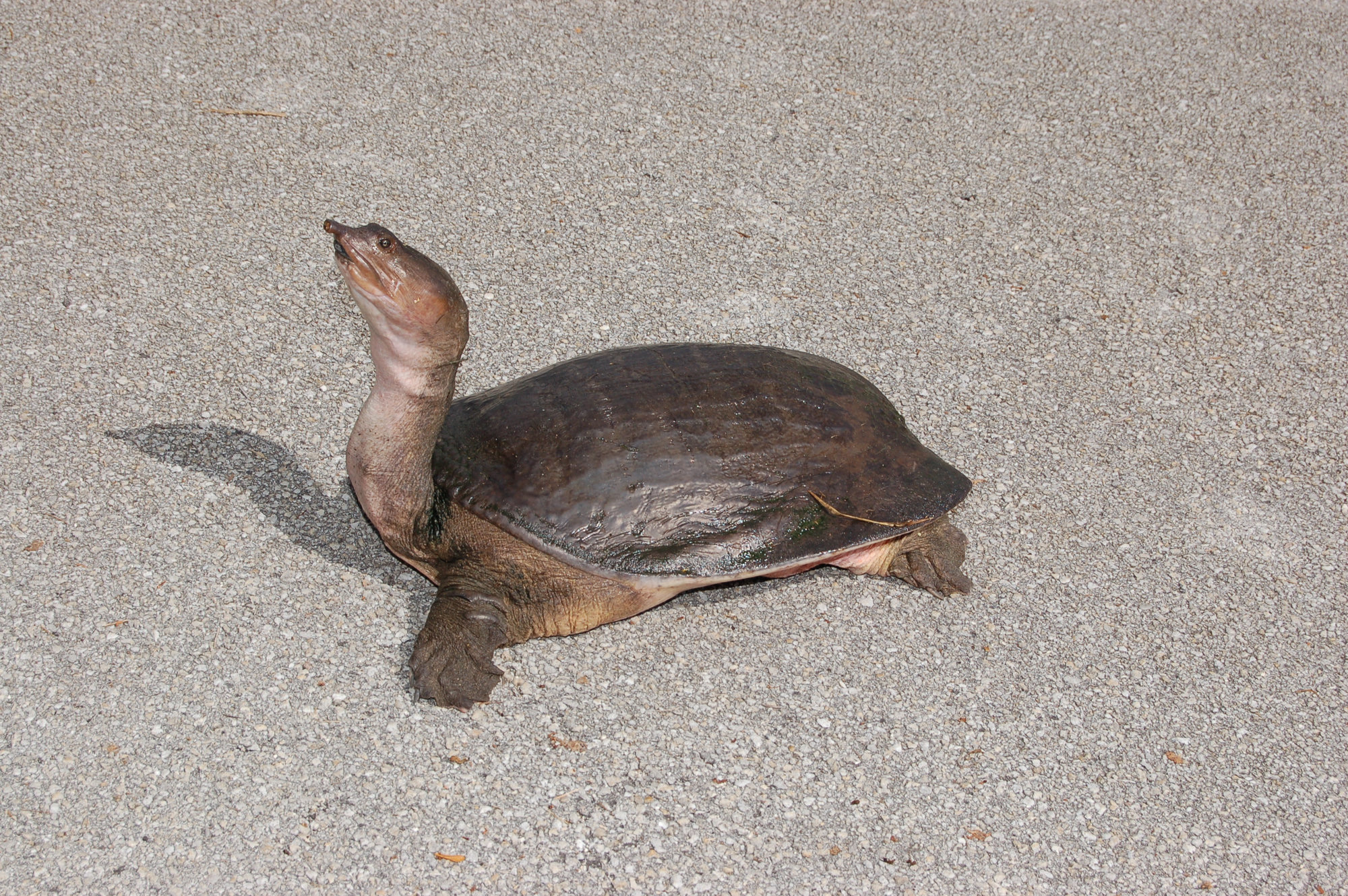
Photo Johnskate17 (opens in a new tab) / Wikimedia Commons, Public domain (opens in a new tab)
At a glance
- Size
- Females up to about 60 cm shell length; males much smaller, about 30 cm
- Habitat
- Ponds, lakes, canals and slow rivers with sandy or muddy bottoms
- Diet
- Snails, fish, crayfish, insects, frogs and carrion
- In Georgia
- The southern Coastal Plain
- Rabies vector
- No
Identification
- Key marks
- Flat, rounded, leathery shell with no scutes; long neck; pointed, tube-like snout
- Told apart from
- Spiny softshell, which has small spines along the front of the shell and lives in western and northern Georgia
- Where to look
- Buried in shallow sand with only the snout showing, or basking on banks
Behaviour
A softshell lies buried in the bottom and stretches its long neck up to breathe through its snorkel-like nose without moving its body. It is fast in water and on land. Having no hard shell to hide in, it defends itself with a quick, reaching bite.
Why they matter
Softshells are among the largest predators and scavengers in southern Georgia's ponds, taking snails and dead fish. Their eggs and young feed many animals, and adults are eaten by alligators.
Reproduction and lifecycle
Nest — Dug in sandy, open ground near water
Eggs — Usually 4 to 38, in several clutches a year
Incubation — About 60 to 80 days
Hatchlings — Olive with dark spots and an orange rim
Maturity — At several years; females larger and slower to mature
Lifespan — Decades
Living around people
- Do not pick one up. The long neck reaches back to the rear of the shell and the bite is strong.
- To help one across a road, encourage it forward from behind, in the direction it was heading, rather than lifting it. Never move it somewhere else.
Misconceptions
- A softshell is a turtle that has lost its shell. The leathery covering is its shell, lighter and flatter than other turtles'.
Related species
Seasonal activity
When this species is breeding, and when there are nests on the ground. Mowing during the shaded months is how most nests are found.
| Jan | Feb | Mar | Apr | May | Jun | Jul | Aug | Sep | Oct | Nov | Dec | |
|---|---|---|---|---|---|---|---|---|---|---|---|---|
| Breeding | Jan: no | Feb: no | Mar: no | Apr: no | May: no | Jun: no | Jul: no | Aug: no | Sep: no | Oct: no | Nov: no | Dec: no |
| Active nests | Jan: no | Feb: no | Mar: no | Apr: no | May: no | Jun: no | Jul: no | Aug: no | Sep: no | Oct: no | Nov: no | Dec: no |
| Notes | Inactive on cold days | Becoming active in warm spells | Active | Courtship; nesting begins | Nesting | Nesting | Nesting ends | Hatching | Hatchlings emerge | Feeding | Slowing down | Mostly inactive |
Where it lives
Recorded in 5 states and provinces. Each one links to the other animals there, and to the rehabilitators licensed for them.
United States
If you found one
Answer a few questions and you will get a specific answer for what you are looking at.
I found an animal