
Species
Coyote
Canis latrans
A highly adaptable canid that now fills much of the medium-sized predator role across North America.
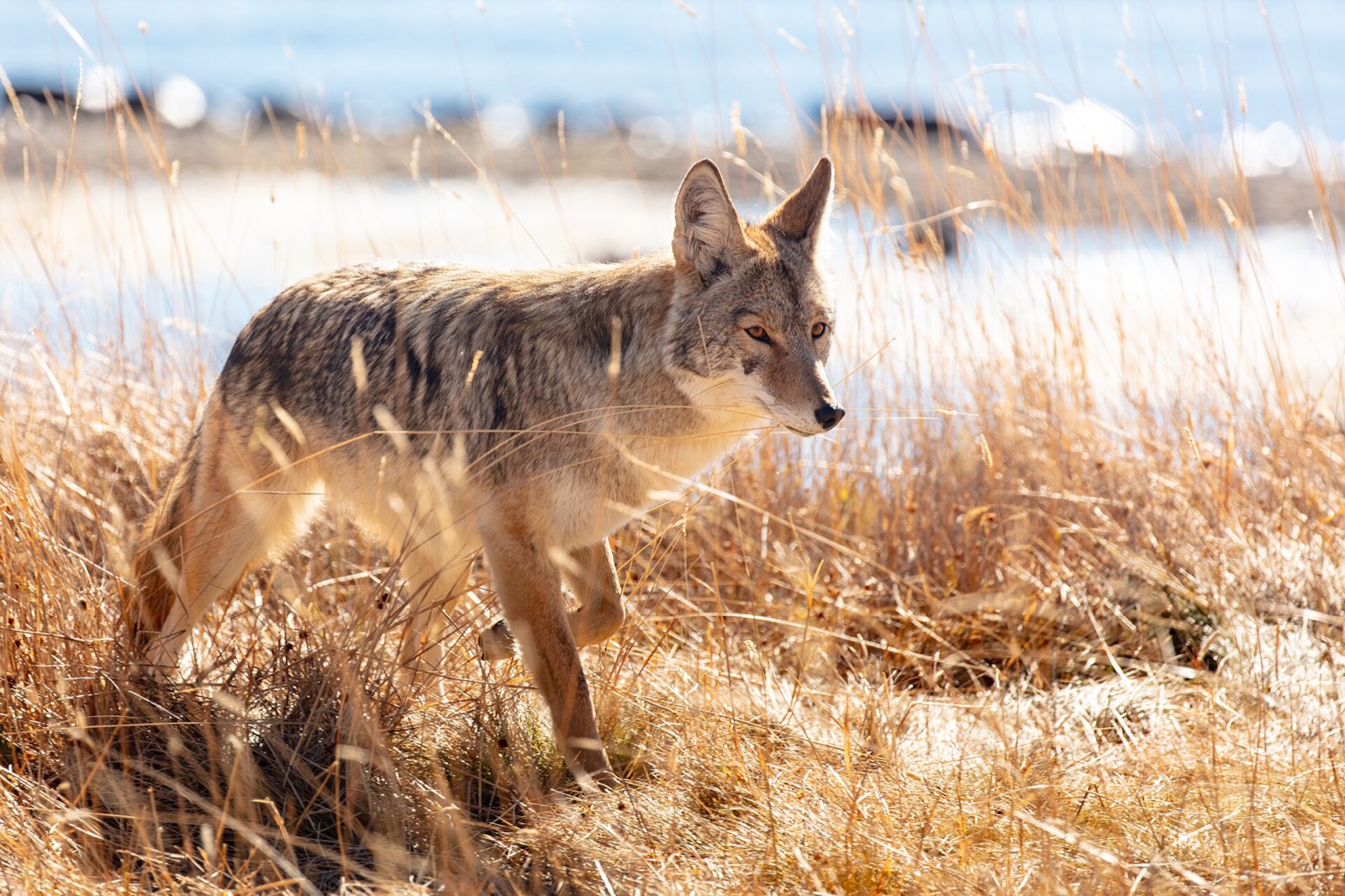
Photo Jacob W. Frank / National Park Service (opens in a new tab), Public domain (opens in a new tab)
At a glance
- Occurrence
- Native to western North America, now established across most of the continent
- Habitat
- Forests, farms, wetlands, suburbs and urban green space
- Diet
- Rodents, rabbits, deer carrion, insects, fruit and other seasonally available foods
- Activity
- Mostly nocturnal and crepuscular in settled areas, with normal daylight activity
- Shelter
- Usually rests in cover; dens are used mainly for raising pups
- Social pattern
- Pairs and small family groups, with many individuals travelling alone
- Rabies vector
- Yes
Identification
- Key marks
- Slender dog-like body, pointed ears, narrow muzzle and a bushy tail usually carried low
- Told apart from
- Domestic dog, which varies enormously but often carries the tail differently and lacks the coyote's consistently narrow build and muzzle
- Where to look
- Forests, farms, wetlands, suburbs and urban green space
Behaviour
It is mostly nocturnal and crepuscular in settled areas, with normal daylight activity. It uses habitats including forests, farms, wetlands, suburbs and urban green space. It feeds on rodents, rabbits, deer carrion, insects, fruit and other seasonally available foods.
Coyotes hunt rodents, rabbits, white-tailed deer (fawns), wild turkeys, small mammals, and other prey but also eat fruit, insects and carrion. They adjust activity to human traffic and often become more nocturnal where people are abundant.
Coyotes alter diet and movement with local conditions, which is one reason they can live in both rural landscapes and major cities.
In suburban and urban areas, where the availability of rodents and rabbits may be uncertain, coyotes may turn to preying upon domestic cats and small dogs (less than 20 pounds), but pets are not their natural choice of prey.
Why they matter
Coyotes are a major medium-sized predator, consuming rodents and carrion and influencing the behavior and abundance of other mammals.
Their flexible social system lets one animal live alone, a mated pair defend a territory or a family group cooperate around pups.
Coyotes are models of family values and humans would do well to learn from coyotes in this regard. Coyote families (not packs) take care of each other, divide labor and responsibilities, and do so across family generations. It's not unusual for pups to grow up and stick around to help mom and dad take care of the next litter, before striking out on their own.
Reproduction and lifecycle
Pairing and mating — mainly January through March, later in the north.
Gestation — about 63 days.
Pups — commonly 4–7 are born in a den in spring.
Dependency — adults and sometimes older siblings provision pups through summer.
Dispersal — many juveniles leave the family territory in autumn or winter.
Living around people
Coyote "escorting" is a natural territorial behavior where a coyote follows a human — and often their dog — at a safe distance as they pass through or near the coyote's home range. Although humans frequently mistake this behavior for stalking or predatory hunting, escorting is actually a defensive tactic designed to push perceived intruders out of the coyote's space.
Despite public fear about the potential for coyote attacks, only about 150 non-rabid coyote attacks on humans have been documented in the United States since the late 1970s, occurring predominantly in suburban regions of California, Arizona, and the western states. Studies of wild canid behavior show that non-rabid attacks stem almost exclusively from human habituation, intentional or unintentional feeding, or pet defense rather than natural predatory instincts toward adults.
There has only been one fatal non-rabid coyote attack in the U.S. The victim was three-year old Kelly Keen, and it occurred in Glendale, California on August 26, 1981.
In stark contrast, an estimated 4.5 million domestic dog bites occur every year in the United States, with an average of 30-50 of those being fatal.
Here are some tips for coexisting with coyotes without conflict:
- Keep cats indoors and supervise small dogs, especially from dusk through dawn.
- Secure rubbish, pet food and fallen fruit so coyotes do not learn to forage near doors and patios.
- Never intentionally feed coyotes.
- If a coyote lingers very close to people, use assertive hazing from a safe position while keeping pets controlled; normal wariness is safer for both people and the animal.
Misconceptions
- A coyote seen in daylight is probably rabid. Daylight activity can be normal, especially when adults are feeding pups; abnormal neurological behaviour is more meaningful than time of day.
- Coyotes form huge wolf-like packs. Coyotes often live as pairs or small family groups, and many travel alone.
- Killing one coyote permanently removes coyotes from a neighbourhood. Vacant territories can be recolonised if food and habitat remain attractive.
Related species
Seasonal activity
When this species is breeding, and when there are nests on the ground. Mowing during the shaded months is how most nests are found.
| Jan | Feb | Mar | Apr | May | Jun | Jul | Aug | Sep | Oct | Nov | Dec | |
|---|---|---|---|---|---|---|---|---|---|---|---|---|
| Breeding | Jan: no | Feb: no | Mar: no | Apr: no | May: no | Jun: no | Jul: no | Aug: no | Sep: no | Oct: no | Nov: no | Dec: no |
| Active nests | Jan: no | Feb: no | Mar: no | Apr: no | May: no | Jun: no | Jul: no | Aug: no | Sep: no | Oct: no | Nov: no | Dec: no |
| Notes | Pair bonds and courtship activity increase; adults may travel and vocalise more. | Peak mating season for coyotes across much of the range. | Pregnancy continues and adults select or prepare den sites. | Pups are commonly born and remain underground or close to the den. | Adults make frequent food trips to growing pups. | Pups emerge regularly and begin learning social and hunting behaviour. | Family groups use larger areas as pups grow. | Young practise hunting and adults continue provisioning. | Juveniles become increasingly independent. | Dispersal season begins and young coyotes may appear in unfamiliar neighbourhoods. | Dispersal continues; adults settle into winter territories. | Pairs spend more time together as the next breeding season approaches. |
If you found one
Answer a few questions and you will get a specific answer for what you are looking at.
I found an animal