
Species
Black-capped petrel
Pterodroma hasitata
An endangered seabird that nests in the mountains of Hispaniola and feeds over the Gulf Stream off Georgia.
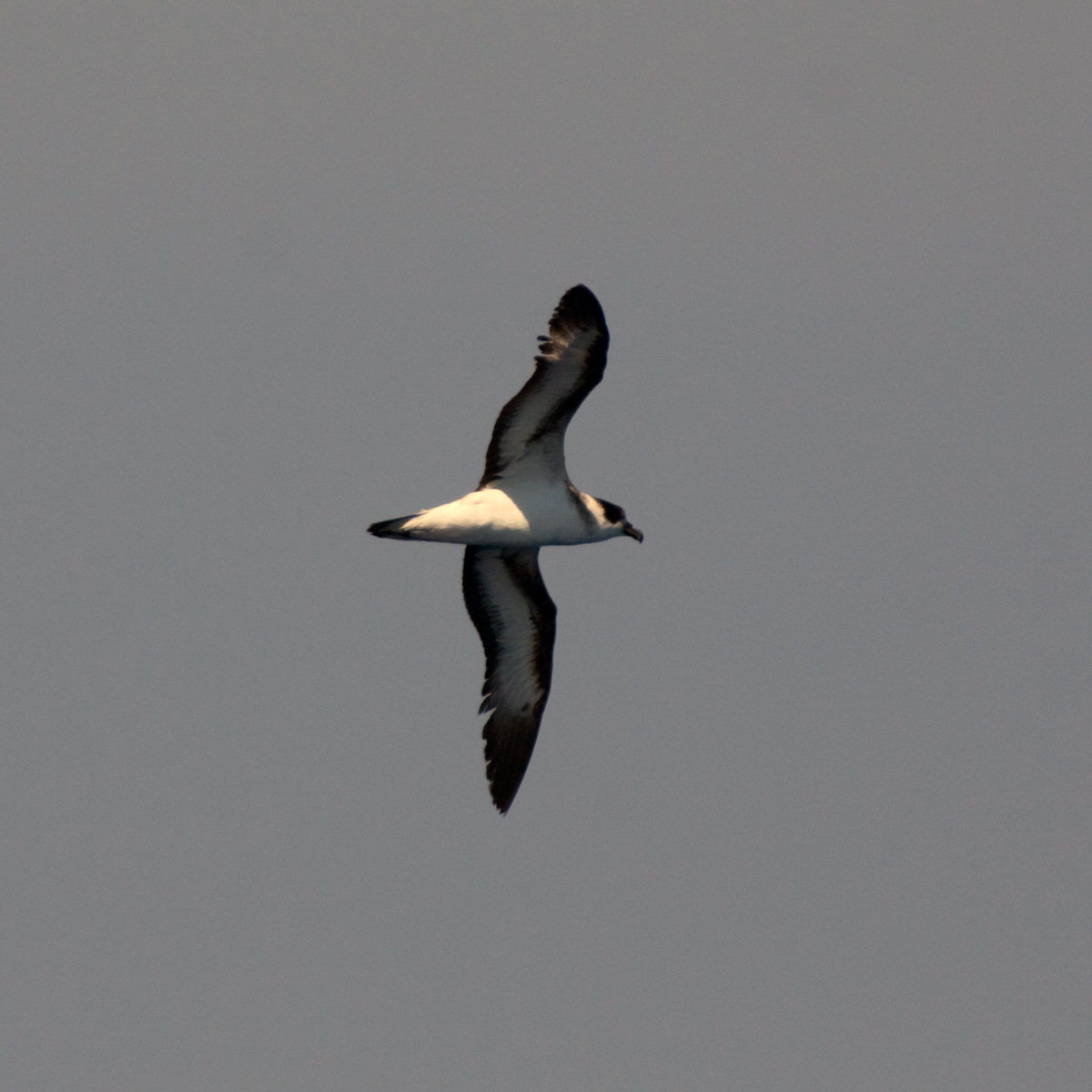
Photo Dan Vickers (opens in a new tab) / iNaturalist, CC BY 4.0 (opens in a new tab)
At a glance
- Size
- About 35 to 40 cm long; wingspan about 95 cm
- Weight
- About 350 to 500 g
- Habitat
- The Gulf Stream and deep water offshore
- Diet
- Squid, small fish and crustaceans taken at the surface
- In Georgia
- Regular far offshore over the Gulf Stream; very rarely blown inland by hurricanes
- Voice
- Silent at sea
- Rabies vector
- No
Identification
- Key marks
- Dark cap and back; white collar and forehead; white rump band; white underparts; fast, arcing flight on stiff wings
- Told apart from
- Great shearwater, which has a dark rump and a different, lower flight
- Told apart from
- Cory's shearwater, which is larger and paler with a yellow bill
- Where to look
- Gulf Stream waters, 70 km or more offshore
Behaviour
Black-capped petrels swing high over the waves in great arcs, using the wind. They visit their nesting burrows only at night, in the mountains of Haiti and the Dominican Republic.
Why they matter
The black-capped petrel is endangered, with perhaps only a few thousand birds left. Almost all of its feeding grounds lie in the Gulf Stream off the southeastern United States, so the waters off Georgia are part of what it needs to survive. Local people on Hispaniola call it the diablotin, the little devil, for its eerie night calls.
Reproduction and lifecycle
Nest — A burrow on steep, forested mountain slopes
Eggs — One
Incubation — About 50 days
Chick — Fed by both parents at night
Lifespan — Long-lived, like other petrels
Living around people
- A petrel found inland after a hurricane is exhausted and needs a rehabilitator; it cannot take off from the ground.
- Bright lights near colonies and on ships at sea disorient petrels at night.
Misconceptions
- Seabirds seen far offshore are strays. Black-capped petrels feed off Georgia as a regular part of their year.
Related species
Seasonal activity
When this species is breeding, and when there are nests on the ground. Mowing during the shaded months is how most nests are found.
| Jan | Feb | Mar | Apr | May | Jun | Jul | Aug | Sep | Oct | Nov | Dec | |
|---|---|---|---|---|---|---|---|---|---|---|---|---|
| Breeding | Jan: no | Feb: no | Mar: no | Apr: no | May: no | Jun: no | Jul: no | Aug: no | Sep: no | Oct: no | Nov: no | Dec: no |
| Active nests | Jan: no | Feb: no | Mar: no | Apr: no | May: no | Jun: no | Jul: no | Aug: no | Sep: no | Oct: no | Nov: no | Dec: no |
| Notes | Nesting in Hispaniola's mountains | Nesting | Chicks in burrows | Chicks | Chicks leaving burrows | Feeding over the Gulf Stream | Offshore | Offshore; hurricanes may carry birds inland | Offshore | Returning to colonies | Courtship at colonies | Nesting begins |
Where it lives
Recorded in 8 states and provinces. Each one links to the other animals there, and to the rehabilitators licensed for them.
If you found one
Answer a few questions and you will get a specific answer for what you are looking at.
I found an animal