
Species
Great shearwater
Ardenna gravis
A dark-capped shearwater that travels in a giant loop around the Atlantic, sometimes washing ashore on Georgia's beaches in early summer.
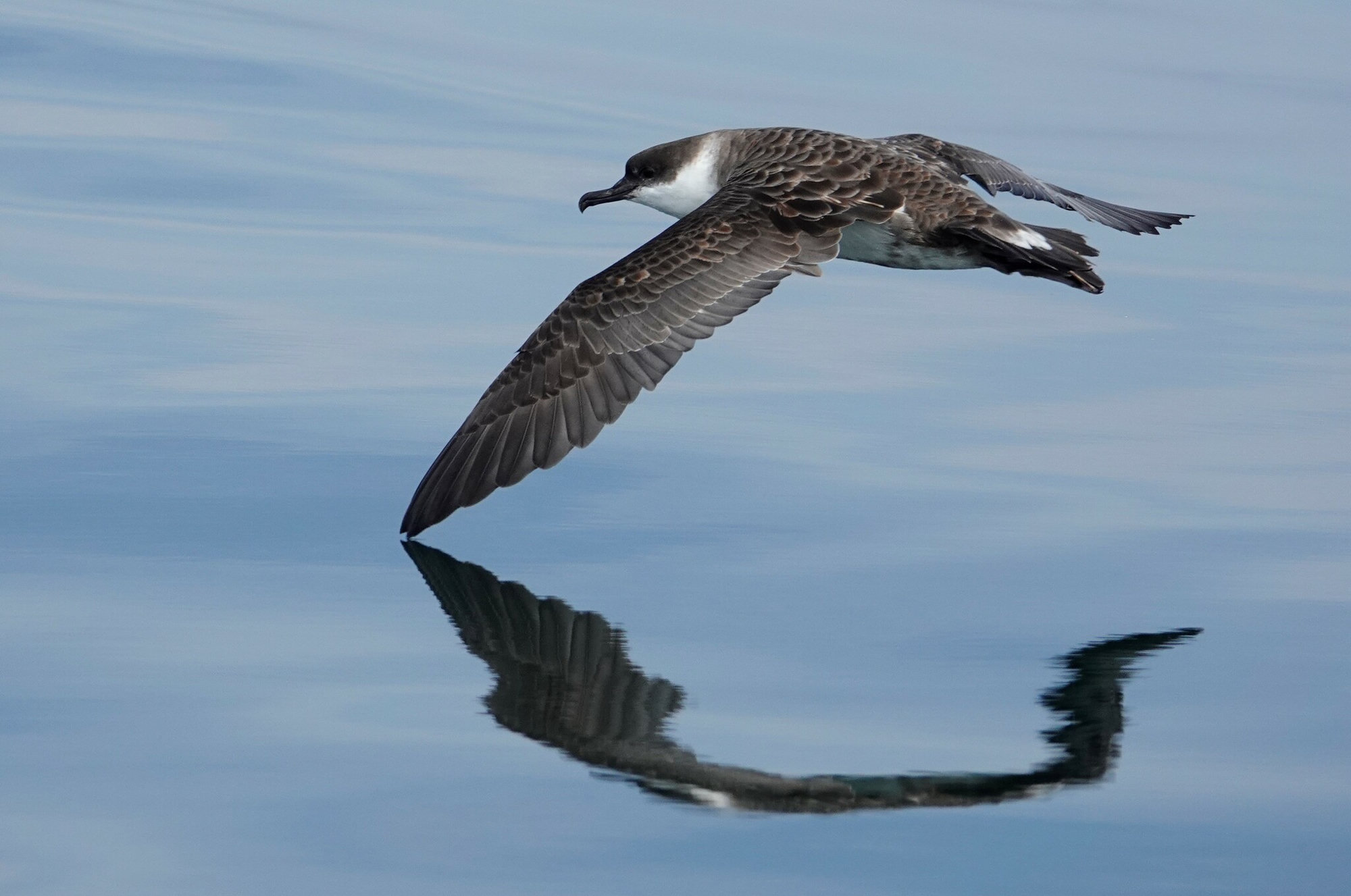
Photo Paul Prior (opens in a new tab) / iNaturalist, CC BY 4.0 (opens in a new tab)
At a glance
- Size
- About 43 to 51 cm long; wingspan about 1 to 1.2 m
- Weight
- About 700 to 950 g
- Habitat
- Open ocean
- Diet
- Fish and squid
- In Georgia
- A common migrant offshore, May to July; sometimes found weak on beaches
- Voice
- Mostly silent at sea
- Rabies vector
- No
Identification
- Key marks
- Dark brown cap; white collar; dark bill; white underparts with a dark belly patch
- Told apart from
- Cory's shearwater, which is paler with a yellow bill
- Where to look
- Offshore in early summer; occasionally stranded on beaches
Behaviour
Great shearwaters breed on remote islands in the South Atlantic and travel in a giant loop through the North Atlantic during the southern winter. Young birds on their first migration sometimes come ashore exhausted.
Why they matter
Great shearwaters make one of the longest migrations of any seabird. When they wash ashore in numbers, it is a signal of hard conditions at sea, such as food shortages or storms.
Reproduction and lifecycle
Nest — A burrow on remote South Atlantic islands
Eggs — One
Incubation — About 55 days
Chick — Fed by both parents
Lifespan — Several decades
Living around people
- A shearwater on the beach cannot take off from sand and should not be put back in the surf; it needs a rehabilitator.
Misconceptions
- Seabirds on the beach are resting. A shearwater ashore is almost always exhausted, starving or injured.
Related species
Seasonal activity
When this species is breeding, and when there are nests on the ground. Mowing during the shaded months is how most nests are found.
| Jan | Feb | Mar | Apr | May | Jun | Jul | Aug | Sep | Oct | Nov | Dec | |
|---|---|---|---|---|---|---|---|---|---|---|---|---|
| Breeding | Jan: no | Feb: no | Mar: no | Apr: no | May: no | Jun: no | Jul: no | Aug: no | Sep: no | Oct: no | Nov: no | Dec: no |
| Active nests | Jan: no | Feb: no | Mar: no | Apr: no | May: no | Jun: no | Jul: no | Aug: no | Sep: no | Oct: no | Nov: no | Dec: no |
| Notes | Breeding in the South Atlantic | Breeding | Chicks | Migrating north | Passing off the Southeast | Offshore; some stranded on beaches | North Atlantic | North Atlantic | Moving south | Moving south | Returning to breeding islands | Breeding |
Where it lives
Recorded in 17 states and provinces. Each one links to the other animals there, and to the rehabilitators licensed for them.
United States
- Delawarepassing through
- Floridapassing through
- Georgiapassing through
- Mainepassing through
- Marylandpassing through
- Massachusettspassing through
- New Hampshirepassing through
- New Jerseypassing through
- New Yorkpassing through
- North Carolinapassing through
- Rhode Islandpassing through
- South Carolinapassing through
- Virginiapassing through
If you found one
Answer a few questions and you will get a specific answer for what you are looking at.
I found an animal