
Species
Belted kingfisher
Megaceryle alcyon
A shaggy-crested, blue-grey kingfisher that rattles along creeks and plunges head first for fish.
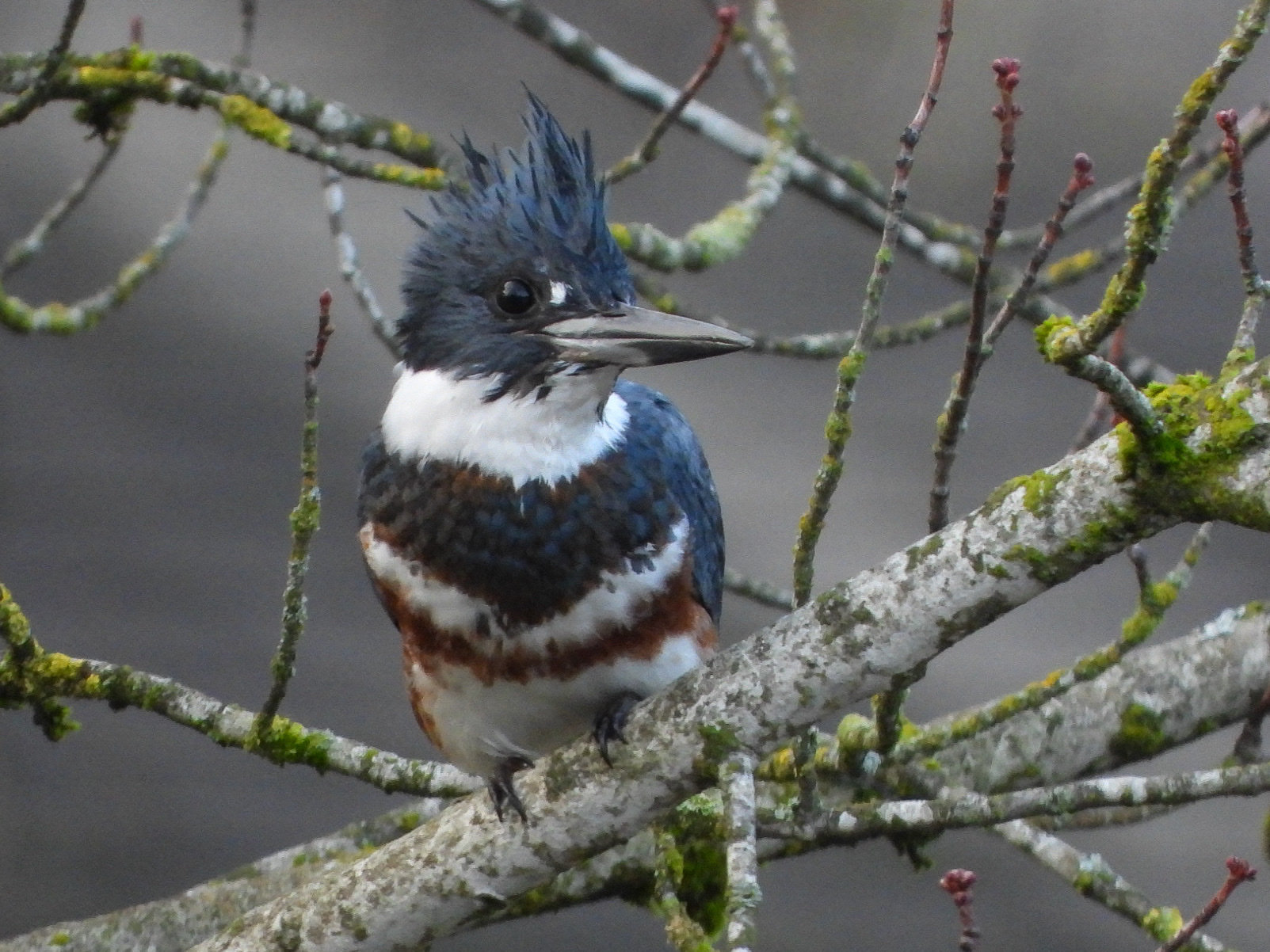
Photo Justin Flint (opens in a new tab) / iNaturalist, CC BY 4.0 (opens in a new tab)
At a glance
- Size
- About 28 to 35 cm long
- Weight
- About 110 to 180 g
- Habitat
- Streams, rivers, ponds, lakes and coastal creeks
- Diet
- Small fish, crayfish, frogs and insects
- In Georgia
- Common all year; more numerous in winter
- Voice
- A loud, dry rattle
- Rabies vector
- No
Identification
- Key marks
- Big head with a shaggy crest; long, heavy bill; blue-grey back and breast band; females also have a rusty band across the belly
- Told apart from
- Blue jay, which has a small bill and a black necklace
- Where to look
- Perched on wires and branches over water, or flying low along streams, rattling
Behaviour
Belted kingfishers hover or perch over water, then dive head first to catch fish. They beat prey against a branch before swallowing it head first.
They dig nest burrows up to two metres long in earthen banks.
Why they matter
The belted kingfisher is unusual among birds in that the female is more colourful than the male. It depends on clear water to see fish and on bare earthen banks for nesting, so it reflects the health of streams.
Reproduction and lifecycle
Nest — A burrow dug into an earthen bank
Eggs — Usually five to eight
Incubation — About 22 to 24 days
Chicks — Fed by both parents
Flight — At about four weeks
Lifespan — Several years
Living around people
- Earthen banks along streams and in gravel pits are nesting sites; they are easily lost to bank-armouring.
- Kingfishers sometimes hit windows near water.
Misconceptions
- The brighter bird is always the male. In kingfishers the female has the extra rusty band.
Related species
Seasonal activity
When this species is breeding, and when there are nests on the ground. Mowing during the shaded months is how most nests are found.
| Jan | Feb | Mar | Apr | May | Jun | Jul | Aug | Sep | Oct | Nov | Dec | |
|---|---|---|---|---|---|---|---|---|---|---|---|---|
| Breeding | Jan: no | Feb: no | Mar: no | Apr: no | May: no | Jun: no | Jul: no | Aug: no | Sep: no | Oct: no | Nov: no | Dec: no |
| Active nests | Jan: no | Feb: no | Mar: no | Apr: no | May: no | Jun: no | Jul: no | Aug: no | Sep: no | Oct: no | Nov: no | Dec: no |
| Notes | Wintering birds join residents | Present | Pairs digging burrows | Nesting | Chicks | Young fledging | Young learning to fish | Present | Migrants arriving | Present | Present | Present |
Where it lives
Recorded in 94 states and provinces. Each one links to the other animals there, and to the rehabilitators licensed for them.
United States
- Alabama
- Alaska
- Arizonain winter
- Arkansas
- Californiain winter
- Colorado
- Connecticut
- Delawarein winter
- District of Columbia
- Floridain winter
- Georgia
- Idaho
- Illinois
- Indiana
- Iowa
- Kansas
- Kentucky
- Louisianain winter
- Maine
- Maryland
- Massachusetts
- Michigan
- Minnesota
- Mississippiin winter
- Missouri
- Montana
- Nebraska
- Nevadain winter
- New Hampshire
- New Jerseyin winter
- New Mexicoin winter
- New York
- North Carolina
- North Dakota
- Ohio
- Oklahoma
- Oregon
- Pennsylvania
- Rhode Island
- South Carolinain winter
- South Dakota
- Tennessee
- Texasin winter
- Utah
- Vermontbreeding
- Virginia
- Washington
- West Virginia
- Wisconsin
- Wyoming
Canada
Mexico
- Aguascalientesin winter
- Baja Californiain winter
- Baja California Surin winter
- Campechein winter
- Chiapasin winter
- Chihuahuain winter
- Coahuilain winter
- Colimain winter
- Durangoin winter
- Guanajuatoin winter
- Guerreroin winter
- Hidalgoin winter
- Jaliscoin winter
- Mexico Cityin winter
- Michoacanin winter
- Morelosin winter
- Nayaritin winter
- Nuevo Leonin winter
- Oaxacain winter
- Pueblain winter
- Queretaroin winter
- Quintana Rooin winter
- San Luis Potosiin winter
- Sinaloain winter
- Sonorain winter
- State of Mexicoin winter
- Tabascoin winter
- Tamaulipasin winter
- Tlaxcalapassing through
- Veracruzin winter
- Yucatanin winter
- Zacatecasin winter
If you found one
Answer a few questions and you will get a specific answer for what you are looking at.
I found an animal