
Species
Baltimore oriole
Icterus galbula
A flame-orange and black oriole that weaves a hanging pouch nest and passes through Georgia in migration.
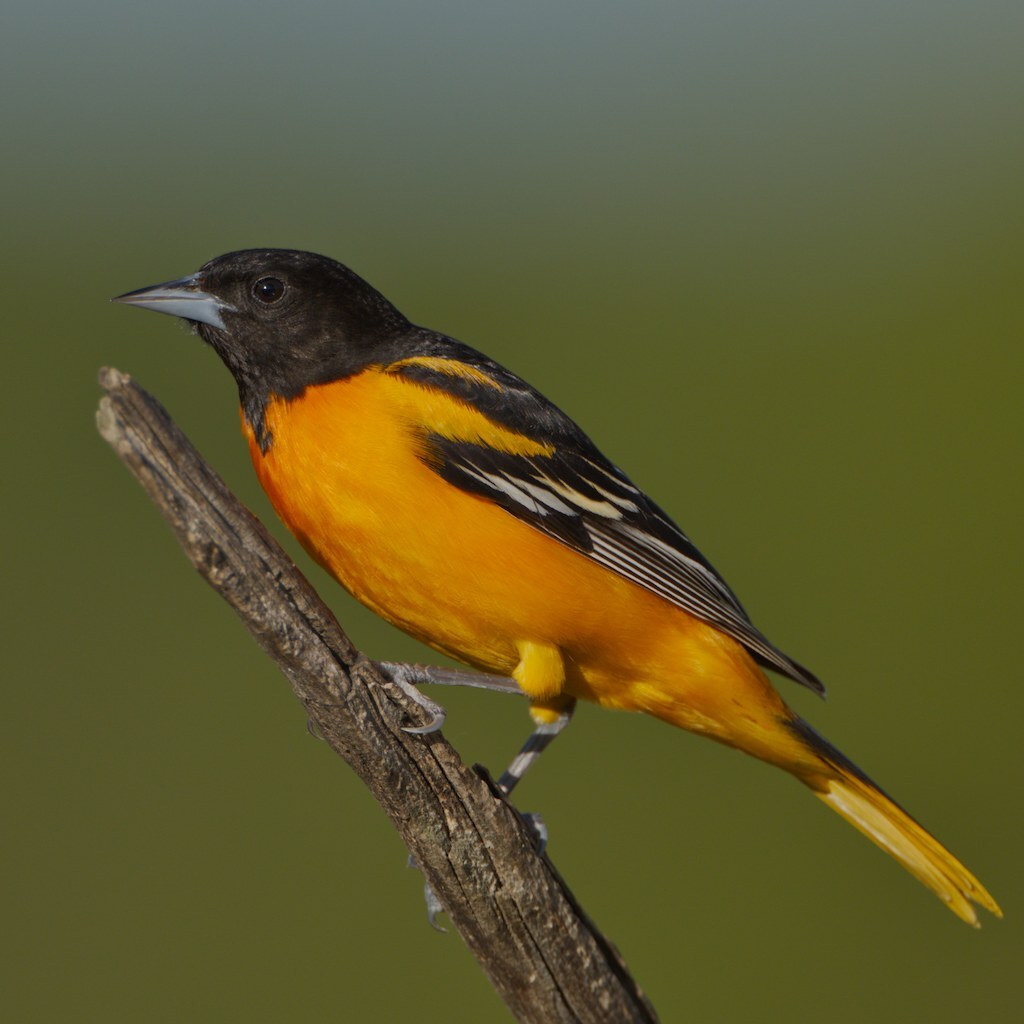
Photo Dmitry Mozzherin (opens in a new tab) / iNaturalist, CC BY 4.0 (opens in a new tab)
At a glance
- Size
- About 17 to 22 cm long
- Weight
- About 30 to 40 g
- Habitat
- Open woods, parks and yards with tall trees
- Diet
- Insects, nectar and fruit
- In Georgia
- A migrant; a few nest in the north; some winter at feeders
- Voice
- Rich, flute-like whistles
- Rabies vector
- No
Identification
- Male
- Bright orange with a black hood and back
- Female
- Yellow-orange with grey-brown wings
- Told apart from
- Orchard oriole, whose male is chestnut
- Where to look
- Tall trees in spring and autumn; feeders in winter
Behaviour
Baltimore orioles weave hanging, pouch-like nests from plant fibres and eat caterpillars, fruit and nectar.
Why they matter
Baltimore orioles eat many tent caterpillars and other pests. They are the state bird of Maryland.
Reproduction and lifecycle
Nest — A woven, hanging pouch at the tip of a branch
Eggs — Usually four or five
Incubation — About 11 to 14 days
Chicks — Fed by both parents
Flight — At about 12 to 14 days
Lifespan — Several years
Living around people
- Orange slices and jelly at feeders attract wintering orioles; feeders should be kept clean.
Misconceptions
- Orioles are named for Baltimore. They are named for Lord Baltimore, whose family colours were orange and black.
Related species
Seasonal activity
When this species is breeding, and when there are nests on the ground. Mowing during the shaded months is how most nests are found.
| Jan | Feb | Mar | Apr | May | Jun | Jul | Aug | Sep | Oct | Nov | Dec | |
|---|---|---|---|---|---|---|---|---|---|---|---|---|
| Breeding | Jan: no | Feb: no | Mar: no | Apr: no | May: no | Jun: no | Jul: no | Aug: no | Sep: no | Oct: no | Nov: no | Dec: no |
| Active nests | Jan: no | Feb: no | Mar: no | Apr: no | May: no | Jun: no | Jul: no | Aug: no | Sep: no | Oct: no | Nov: no | Dec: no |
| Notes | A few wintering | A few wintering | Few present | Migrants arriving | Nesting in the north | Nesting | Young fledging | Migrants | Migrants | Last migrants | A few wintering | A few wintering |
Where it lives
Recorded in 65 states and provinces. Each one links to the other animals there, and to the rehabilitators licensed for them.
United States
- Alabamain winter
- Arkansasbreeding
- Coloradobreeding
- Connecticutbreeding
- Delawarebreeding
- District of Columbiabreeding
- Floridain winter
- Georgiain winter
- Illinoisbreeding
- Indianabreeding
- Iowabreeding
- Kansasbreeding
- Kentuckybreeding
- Louisiana
- Mainebreeding
- Marylandbreeding
- Massachusettsbreeding
- Michiganbreeding
- Minnesotabreeding
- Mississippibreeding
- Missouribreeding
- Montanabreeding
- Nebraskabreeding
- New Hampshirebreeding
- New Jerseybreeding
- New Yorkbreeding
- North Carolinain winter
- North Dakotabreeding
- Ohiobreeding
- Oklahomabreeding
- Pennsylvaniabreeding
- Rhode Islandbreeding
- South Carolinain winter
- South Dakotabreeding
- Tennesseebreeding
- Texaspassing through
- Vermontbreeding
- Virginia
- West Virginiabreeding
- Wisconsinbreeding
Canada
Mexico
- Campechein winter
- Chiapasin winter
- Guerreroin winter
- Hidalgoin winter
- Jaliscoin winter
- Michoacanin winter
- Morelosin winter
- Nuevo Leonpassing through
- Oaxacain winter
- Pueblain winter
- Quintana Rooin winter
- San Luis Potosiin winter
- State of Mexicoin winter
- Tabascoin winter
- Tamaulipasin winter
- Veracruzin winter
- Yucatanin winter
If you found one
Answer a few questions and you will get a specific answer for what you are looking at.
I found an animal