
Species
Alabama map turtle
Graptemys pulchra
A knob-backed river turtle of northwest Georgia's Coosa river system.
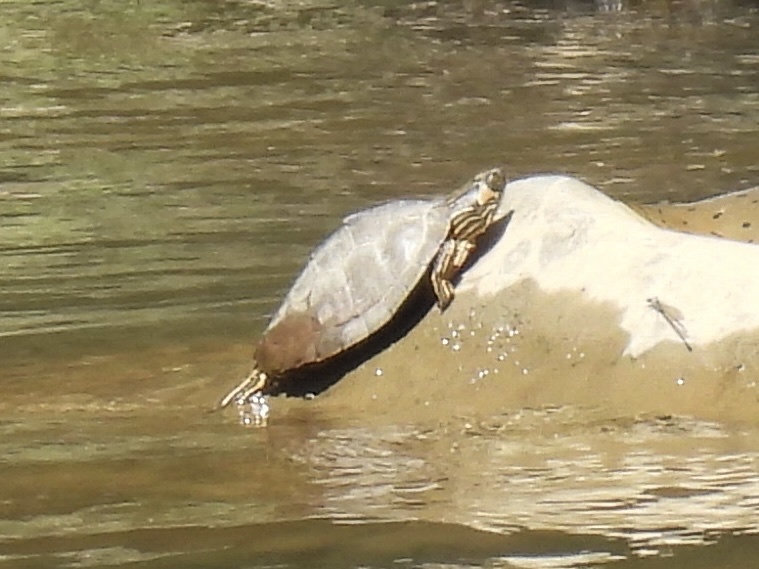
Photo novvictan (opens in a new tab) / iNaturalist, CC BY 4.0 (opens in a new tab)
At a glance
- Size
- Females up to about 29 cm shell length; males much smaller
- Habitat
- Rivers with fallen trees and snags
- Diet
- Females eat snails and mussels; males eat insects
- In Georgia
- The Coosa river system of northwest Georgia
- Rabies vector
- No
Identification
- Key marks
- Olive shell with dark-tipped knobs along the midline; broad light blotch on the head; females have very large heads
- Told apart from
- Northern map turtle, which has a lower keel and small spot behind the eye
- Where to look
- Basking on snags in rivers
Behaviour
Like its relatives it basks on logs in the current and drops into the water at the first disturbance. Females and males eat different food, which their very different head sizes suit.
Why they matter
It lives only in the Mobile Bay river basin, including Georgia's Coosa system, so its rivers matter to the whole species.
Reproduction and lifecycle
Nest — Dug on sandbars and banks
Eggs — Usually 5 to 10, in several clutches
Incubation — About 60 to 80 days
Hatchlings — Small and patterned
Maturity — Females take many years
Lifespan — Decades
Living around people
- Fallen trees and clean water are what these turtles need.
Misconceptions
- The knobs on the shell are injuries. They are part of the shell's normal shape.
Related species
Seasonal activity
When this species is breeding, and when there are nests on the ground. Mowing during the shaded months is how most nests are found.
| Jan | Feb | Mar | Apr | May | Jun | Jul | Aug | Sep | Oct | Nov | Dec | |
|---|---|---|---|---|---|---|---|---|---|---|---|---|
| Breeding | Jan: no | Feb: no | Mar: no | Apr: no | May: no | Jun: no | Jul: no | Aug: no | Sep: no | Oct: no | Nov: no | Dec: no |
| Active nests | Jan: no | Feb: no | Mar: no | Apr: no | May: no | Jun: no | Jul: no | Aug: no | Sep: no | Oct: no | Nov: no | Dec: no |
| Notes | Inactive | Basking on warm days | Active | Courtship | Nesting | Nesting | Nesting | Hatching | Hatchlings emerge | Feeding | Slowing down | Mostly inactive |
Where it lives
Recorded in 3 states and provinces. Each one links to the other animals there, and to the rehabilitators licensed for them.
United States
If you found one
Answer a few questions and you will get a specific answer for what you are looking at.
I found an animal