
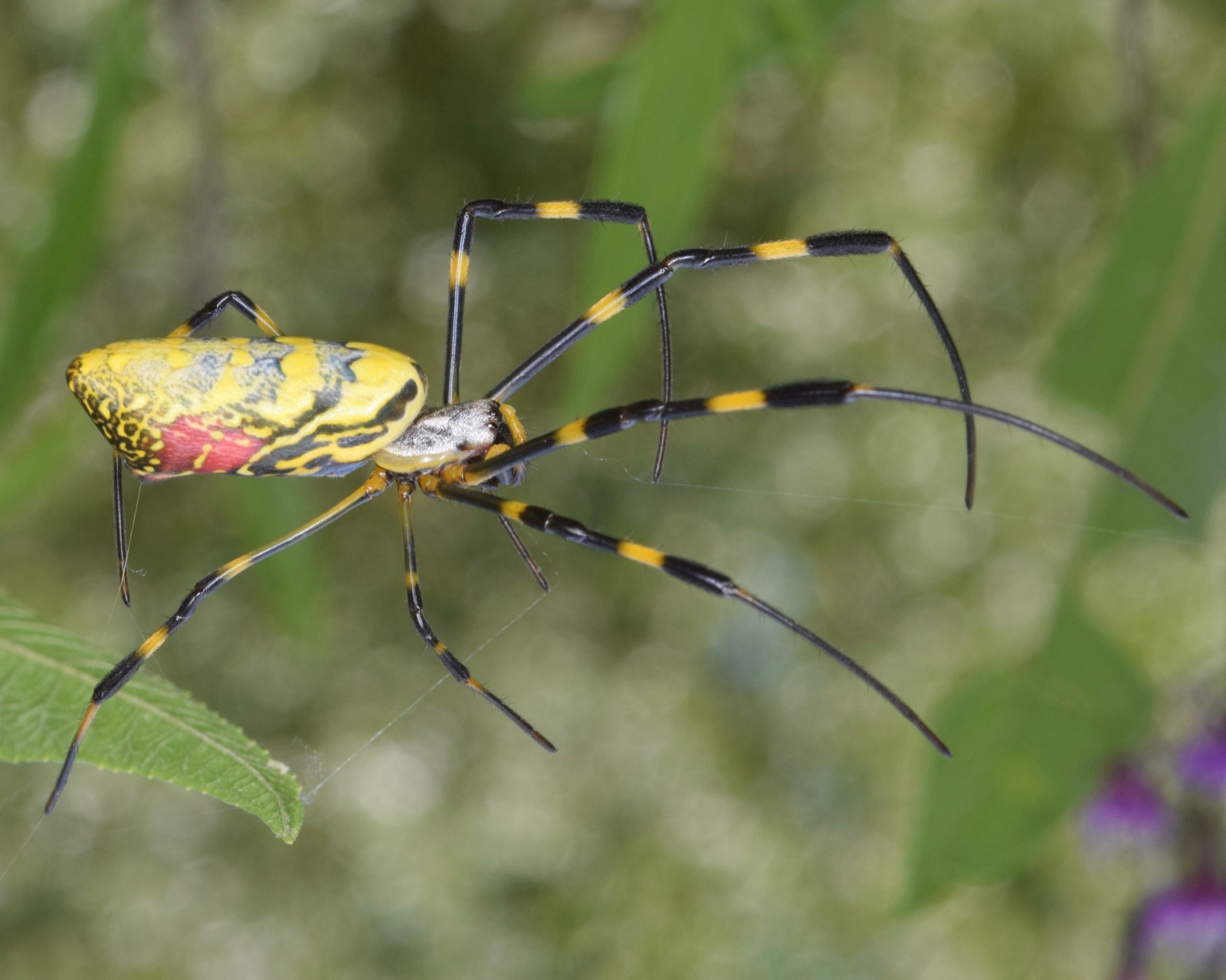
Photo Christina Butler (opens in a new tab), CC BY 2.0 (opens in a new tab)
A large spider is not necessarily a dangerous spider
Orb-weavers build webs to catch flying insects, not people. Native spotted orb-weavers and introduced Joro spiders are generally reluctant to bite. The easiest solution to an inconvenient web is often simply to give it space or move the spider/web out of a high-contact area.
Joro nuance matters
Joro spiders are nonnative and established in the Southeast. UGA researchers continue to study their ecological effects. That makes two extreme claims equally unhelpful: “they are harmless in every ecological sense” and “they are destroying everything.” The honest answer is that human-health risk is low while ecosystem effects are still being studied.
Spiders are pest control with eight legs
Most landscape spiders prey on insects. A web near a light can become a remarkably efficient insect trap, reducing moths, flies and other flying prey.
What to do
- Leave spiders alone when webs are not in the way.
- Use a broom or stick to relocate a web from a doorway rather than spraying broad-spectrum insecticide.
- Avoid area-wide pesticide treatments that also kill pollinators and native arthropods.
- Report Joro observations through recognized citizen-science programs if useful to researchers.
- Teach children to look, not grab.
Comfort with spiders does not require pretending every species has identical ecological effects. It means separating human fear from evidence, appreciating the work spiders do, and responding proportionally when a web is inconvenient.