
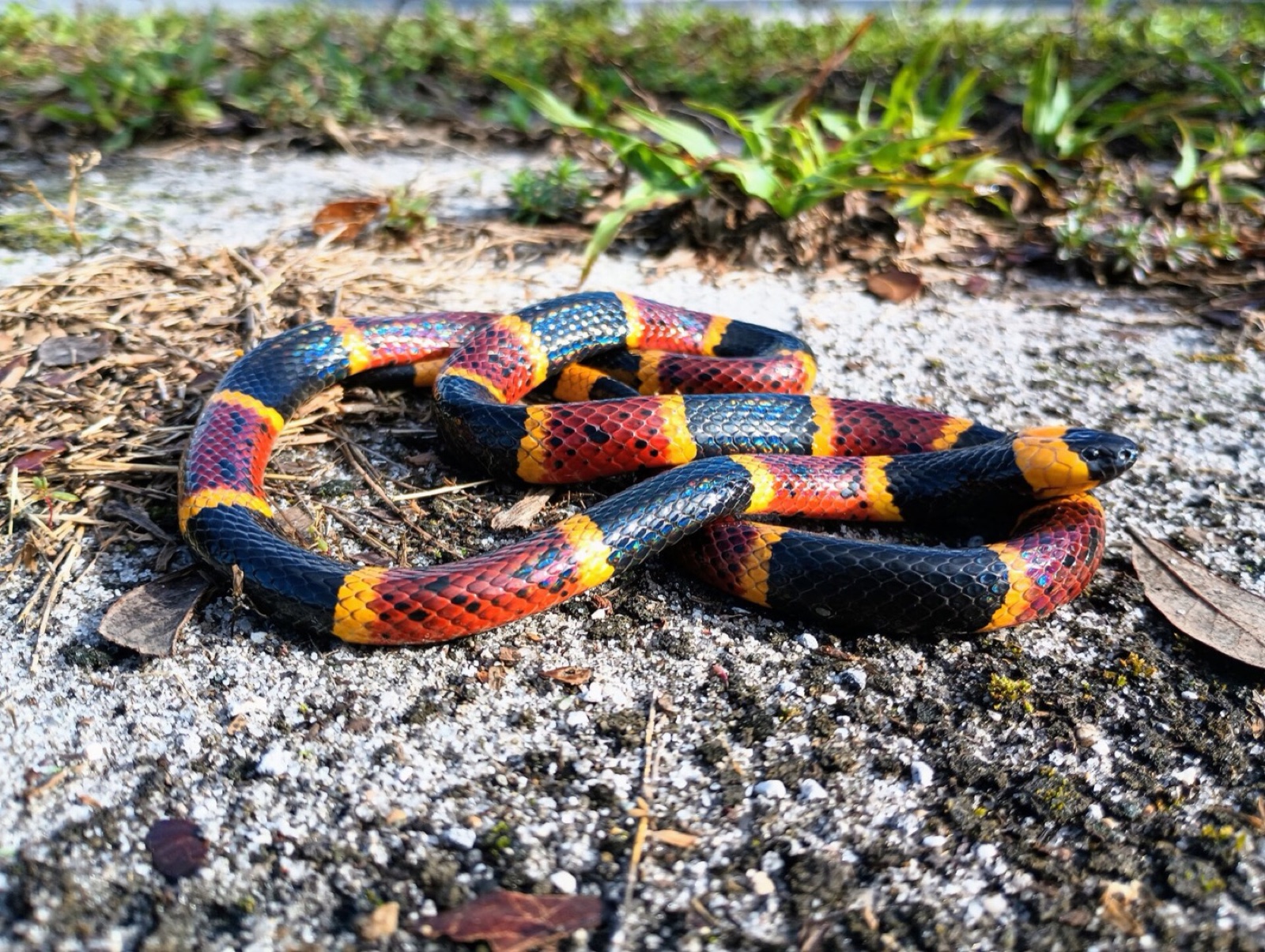
Photo no rights reserved (opens in a new tab), CC0 (opens in a new tab)
A different kind of venomous snake
Unlike the region’s pit vipers, coral snakes are elapids, relatives of cobras and mambas. They have fixed front fangs and neurotoxic venom. A bite is a medical emergency even if pain or swelling is initially limited.
Do not trust a rhyme as your only ID
The familiar color rhyme can be useful in a narrow regional context but is not a universal snake-identification system. Pattern anomalies and nonnative snakes can break simple rules. Use range, head color and complete pattern, and do not handle a snake to test the rhyme.
Why persecution is especially unnecessary
Coral snakes are secretive and generally try to avoid exposure. A sighting can be a rare natural-history moment rather than an emergency.
What to do
- Never handle a tricolored snake you cannot confidently identify.
- Use photographs from a distance.
- Keep hands out of logs, debris and underground refuges you cannot see into.
- If a coral snake is in a residence, use a qualified professional.
- Treat any suspected bite as an emergency.
> Safety note: Suspected coral snake bites require urgent medical evaluation. Do not wait for dramatic local symptoms.
The coral snake is a good reminder that “venomous” and “aggressive” are not synonyms. Serious medical potential can coexist with a secretive animal that would much rather disappear than interact with us.