
Species
Southern hognose snake
Heterodon simus
A small, rare hognose of sandhills with a sharply upturned snout for digging out toads.
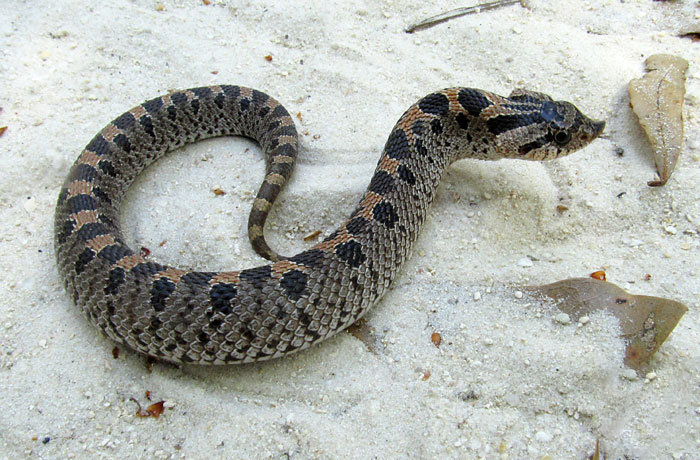
Photo Glenn Bartolotti (opens in a new tab) / Wikimedia Commons, CC BY-SA 3.0 (opens in a new tab)
At a glance
- Size
- Usually 35 to 55 cm long
- Habitat
- Sandhills, longleaf pine woods and dry, sandy fields
- Diet
- Toads, frogs and lizards
- In Georgia
- The Coastal Plain; rare
- Venomous
- No
- Rabies vector
- No
Identification
- Key marks
- Stout, pale with dark blotches; sharply upturned snout; dark underside of the tail no darker than the belly
- Told apart from
- Eastern hognose snake, which is larger with a blunter snout
- Where to look
- In deep sand; rarely seen
Behaviour
Like its larger relative it bluffs, hisses and may play dead. It digs through sand with its snout to find toads.
Why they matter
It has disappeared from much of its range with the loss of sandhills and longleaf pine, and is one of the rarest snakes of the Southeast.
Reproduction and lifecycle
Eggs — Usually 6 to 10
Nest — In loose sand
Incubation — About 60 days
Hatchlings — Small and blotched
Maturity — In a few years
Lifespan — Several years
Living around people
- It is harmless; any sighting of this rare snake is worth recording on iNaturalist.
Misconceptions
- It is venomous. It is harmless and bluffs.
Related species
Seasonal activity
When this species is breeding, and when there are nests on the ground. Mowing during the shaded months is how most nests are found.
| Jan | Feb | Mar | Apr | May | Jun | Jul | Aug | Sep | Oct | Nov | Dec | |
|---|---|---|---|---|---|---|---|---|---|---|---|---|
| Breeding | Jan: no | Feb: no | Mar: no | Apr: no | May: no | Jun: no | Jul: no | Aug: no | Sep: no | Oct: no | Nov: no | Dec: no |
| Active nests | Jan: no | Feb: no | Mar: no | Apr: no | May: no | Jun: no | Jul: no | Aug: no | Sep: no | Oct: no | Nov: no | Dec: no |
| Notes | Underground | Underground | Emerging | Active | Mating | Laying | Active | Hatching | Active | Active | Underground | Underground |
Where it lives
Recorded in 4 states and provinces. Each one links to the other animals there, and to the rehabilitators licensed for them.
United States
If you found one
Answer a few questions and you will get a specific answer for what you are looking at.
I found an animal