
Species
Peregrine falcon
Falco peregrinus
The fastest animal on Earth, which dives on prey at over 300 km an hour, now nesting on city buildings.
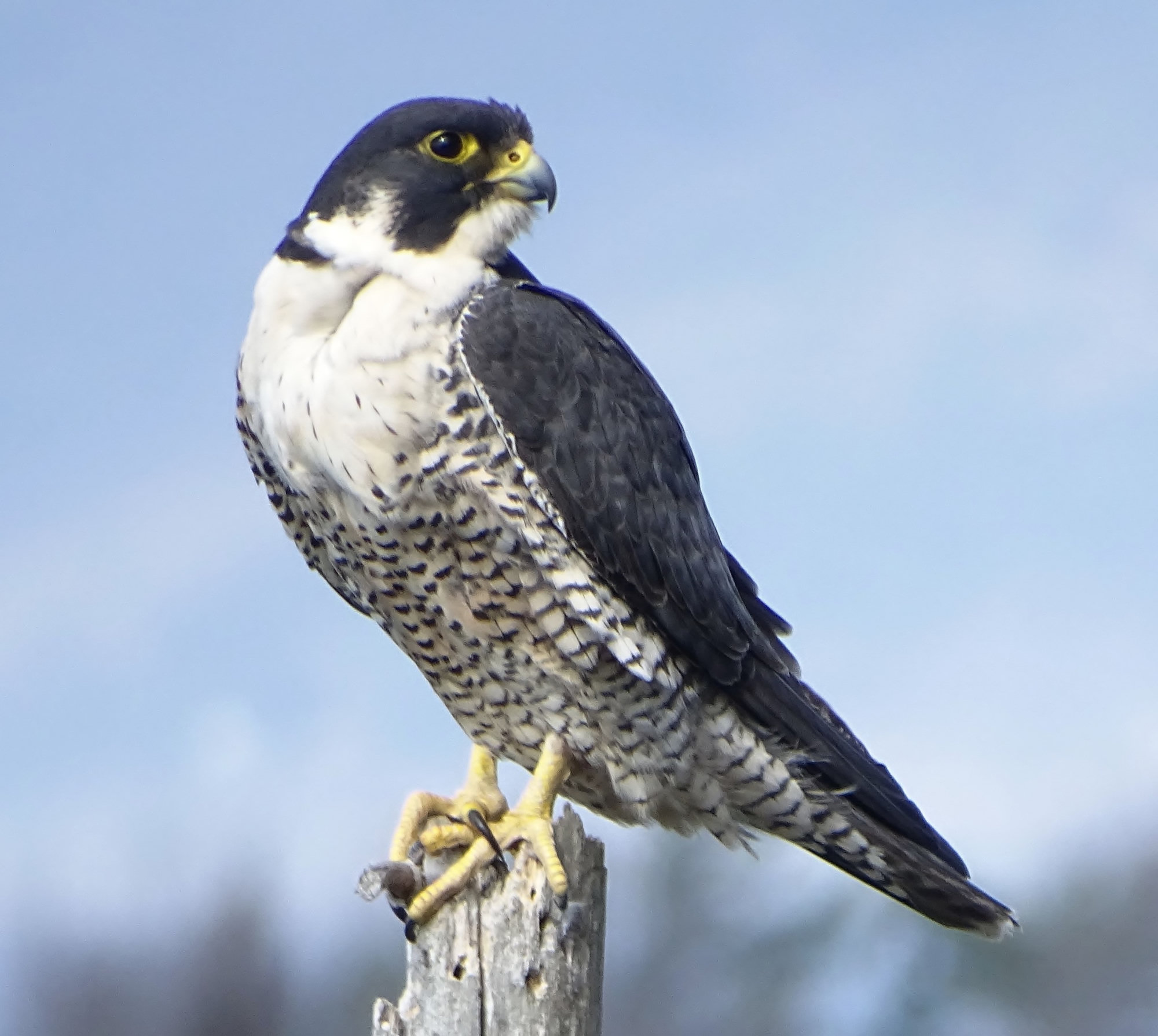
Photo Shirley Zundell (opens in a new tab) / iNaturalist, CC BY 4.0 (opens in a new tab)
At a glance
- Size
- About 36 to 49 cm long; wingspan about 1 to 1.1 m
- Weight
- About 530 to 1,600 g
- Habitat
- Coasts, cities, cliffs and open country
- Diet
- Birds, especially pigeons, ducks and shorebirds
- In Georgia
- An uncommon migrant and winter visitor, mostly on the coast; a few pairs nest on buildings
- Voice
- A harsh "kak-kak-kak" near the nest
- Rabies vector
- No
Identification
- Key marks
- Large falcon; dark hood and a bold moustache mark; blue-grey back in adults; pointed wings
- Told apart from
- Merlin, which is much smaller
- Told apart from
- Mississippi kite, which is slimmer with no moustache
- Where to look
- Coastal beaches in autumn; tall buildings in Atlanta
Behaviour
Peregrines hunt birds in the air, diving in a "stoop" at speeds measured above 300 km an hour and striking prey with their feet.
Why they matter
Peregrine falcons disappeared from the eastern United States by the 1960s because of DDT. Captive breeding and releases, including on city buildings, brought them back, and they were removed from the endangered species list in 1999 — one of the best-known conservation recoveries. In cities they hunt feral pigeons.
Reproduction and lifecycle
Nest — A scrape on a cliff ledge or a building ledge
Eggs — Usually three or four
Incubation — About 29 to 33 days
Chicks — Fed by both parents
Flight — At about six weeks
Lifespan — Wild birds over fifteen years are recorded
Living around people
- Young peregrines leaving city nests sometimes land on streets; they need a rehabilitator or a trained volunteer, not a push back into the air.
Misconceptions
- Peregrines are still endangered. They recovered and were removed from the endangered list.
Related species
Seasonal activity
When this species is breeding, and when there are nests on the ground. Mowing during the shaded months is how most nests are found.
| Jan | Feb | Mar | Apr | May | Jun | Jul | Aug | Sep | Oct | Nov | Dec | |
|---|---|---|---|---|---|---|---|---|---|---|---|---|
| Breeding | Jan: no | Feb: no | Mar: no | Apr: no | May: no | Jun: no | Jul: no | Aug: no | Sep: no | Oct: no | Nov: no | Dec: no |
| Active nests | Jan: no | Feb: no | Mar: no | Apr: no | May: no | Jun: no | Jul: no | Aug: no | Sep: no | Oct: no | Nov: no | Dec: no |
| Notes | Wintering | Wintering; city pairs courting | City pairs nesting | Incubating | Chicks | Young fledging | Young learning to hunt | Present | Migrants arriving on the coast | Peak migration | Wintering | Wintering |
Where it lives
Recorded in 95 states and provinces. Each one links to the other animals there, and to the rehabilitators licensed for them.
United States
- Alabamain winter
- Alaska
- Arizona
- Arkansasin winter
- California
- Coloradobreeding
- Connecticutin winter
- Delawarein winter
- District of Columbiain winter
- Floridain winter
- Georgia
- Idaho
- Illinois
- Indiana
- Iowa
- Kansas
- Kentucky
- Louisianain winter
- Maine
- Maryland
- Massachusettsin winter
- Michigan
- Minnesota
- Mississippiin winter
- Missouriin winter
- Montanabreeding
- Nebraska
- Nevada
- New Hampshire
- New Jersey
- New Mexico
- New York
- North Carolinain winter
- North Dakotabreeding
- Ohioin winter
- Oklahomapassing through
- Oregon
- Pennsylvania
- Rhode Island
- South Carolinain winter
- South Dakotabreeding
- Tennesseein winter
- Texasin winter
- Utah
- Vermont
- Virginiain winter
- Washingtonin winter
- West Virginia
- Wisconsin
- Wyomingbreeding
Canada
Mexico
- Aguascalientesbreeding
- Baja California
- Baja California Sur
- Campechein winter
- Chiapasin winter
- Chihuahuain winter
- Coahuila
- Colimain winter
- Durangoin winter
- Guanajuatoin winter
- Guerreroin winter
- Hidalgoin winter
- Jalisco
- Mexico City
- Michoacanin winter
- Morelosin winter
- Nayaritin winter
- Nuevo Leon
- Oaxacain winter
- Pueblain winter
- Queretaroin winter
- Quintana Rooin winter
- San Luis Potosiin winter
- Sinaloa
- Sonora
- State of Mexico
- Tabascoin winter
- Tamaulipasin winter
- Tlaxcalapassing through
- Veracruzin winter
- Yucatanin winter
- Zacatecasbreeding
If you found one
Answer a few questions and you will get a specific answer for what you are looking at.
I found an animal