
Species
Broad-winged hawk
Buteo platypterus
A compact forest hawk that migrates in huge swirling flocks, called kettles, riding thermals south in September.
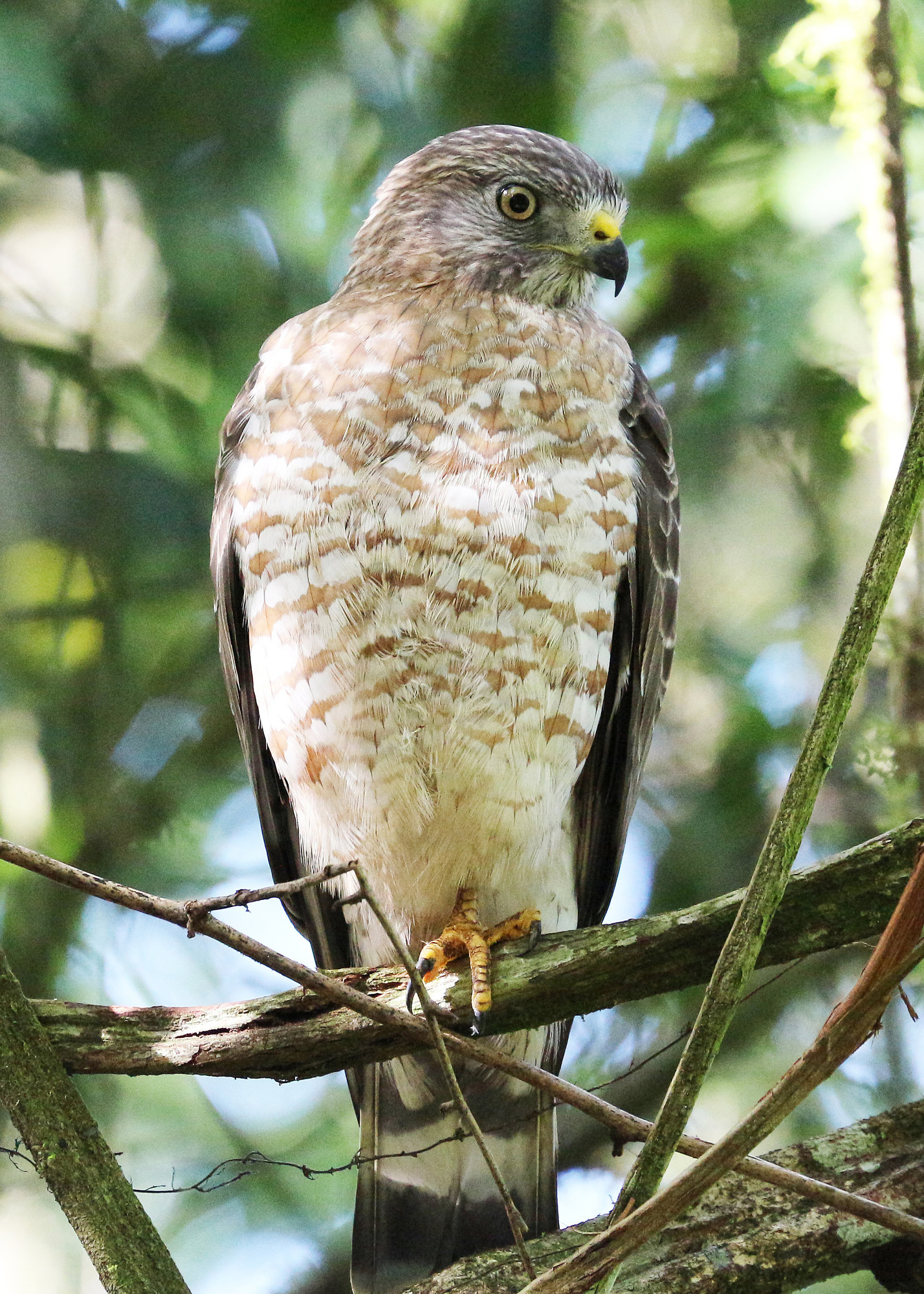
Photo Bernard Gagnon (opens in a new tab) / Wikimedia Commons, CC0 (opens in a new tab)
At a glance
- Size
- About 34 to 44 cm long
- Weight
- About 265 to 560 g
- Habitat
- Large deciduous and mixed forests
- Diet
- Frogs, toads, snakes, rodents, insects and small birds
- In Georgia
- A summer resident in the north; common migrant in September
- Voice
- A high, thin whistle "peeeee"
- Rabies vector
- No
Identification
- Key marks
- Compact hawk; broad black-and-white bands on the tail; pale underwings with a dark border
- Told apart from
- Red-shouldered hawk, which has narrow white tail bands and rusty underparts
- Where to look
- Kettles of migrating hawks over ridges in mid to late September
Behaviour
Broad-winged hawks hunt from perches inside forests. In autumn they migrate in flocks of thousands, spiralling up on rising warm air and gliding south to Central and South America.
Why they matter
Broad-winged hawks make one of the most spectacular migrations of any North American raptor. They depend on large, unbroken forests for nesting, and their numbers help track the health of those forests.
Reproduction and lifecycle
Nest — A small platform of sticks in a tree
Eggs — Usually two or three
Incubation — About 28 to 31 days
Chicks — Fed by both parents
Flight — At about five to six weeks
Lifespan — Several years
Living around people
- Forest fragmentation reduces their nesting habitat.
Misconceptions
- Hawks migrate alone. Broad-winged hawks migrate in huge flocks.
Related species
Seasonal activity
When this species is breeding, and when there are nests on the ground. Mowing during the shaded months is how most nests are found.
| Jan | Feb | Mar | Apr | May | Jun | Jul | Aug | Sep | Oct | Nov | Dec | |
|---|---|---|---|---|---|---|---|---|---|---|---|---|
| Breeding | Jan: no | Feb: no | Mar: no | Apr: no | May: no | Jun: no | Jul: no | Aug: no | Sep: no | Oct: no | Nov: no | Dec: no |
| Active nests | Jan: no | Feb: no | Mar: no | Apr: no | May: no | Jun: no | Jul: no | Aug: no | Sep: no | Oct: no | Nov: no | Dec: no |
| Notes | In South America | In South America | In South America | Arriving in north Georgia | Nesting | Nesting | Chicks | Young flying | Peak migration | Last migrants | In South America | In South America |
Where it lives
Recorded in 68 states and provinces. Each one links to the other animals there, and to the rehabilitators licensed for them.
United States
- Alabamabreeding
- Arkansasbreeding
- Coloradopassing through
- Connecticutbreeding
- Delawarepassing through
- District of Columbiapassing through
- Florida
- Georgiabreeding
- Idahoin winter
- Illinoisbreeding
- Indianabreeding
- Iowabreeding
- Kansasbreeding
- Kentuckybreeding
- Louisianabreeding
- Mainebreeding
- Marylandbreeding
- Massachusettsbreeding
- Michiganbreeding
- Minnesotabreeding
- Mississippibreeding
- Missouribreeding
- Montanapassing through
- Nebraskabreeding
- New Hampshirebreeding
- New Jerseybreeding
- New Yorkbreeding
- North Carolinabreeding
- North Dakotabreeding
- Ohiobreeding
- Oklahomabreeding
- Pennsylvaniabreeding
- Rhode Islandbreeding
- South Carolinabreeding
- South Dakotabreeding
- Tennesseebreeding
- Texasbreeding
- Vermontbreeding
- Virginiabreeding
- West Virginiabreeding
- Wisconsinbreeding
- Wyomingpassing through
Canada
Mexico
- Baja California Surin winter
- Chiapasin winter
- Guerreropassing through
- Jaliscoin winter
- Mexico Cityin winter
- Michoacanin winter
- Morelosin winter
- Nayaritin winter
- Nuevo Leonin winter
- Oaxacain winter
- Pueblain winter
- Queretaroin winter
- San Luis Potosipassing through
- Sinaloain winter
- State of Mexicoin winter
- Tabascopassing through
- Tamaulipaspassing through
- Veracruzpassing through
If you found one
Answer a few questions and you will get a specific answer for what you are looking at.
I found an animal